Operations
Part of Real Estate SEO: A Practical Operating Framework
5 Things to Check Before Trusting Real Estate SEO Benchmarks
real estate SEO benchmarks in 2027 require stable query and page groups, clear metric definitions, field performance data, business outcomes, and decision ranges.
The five checks
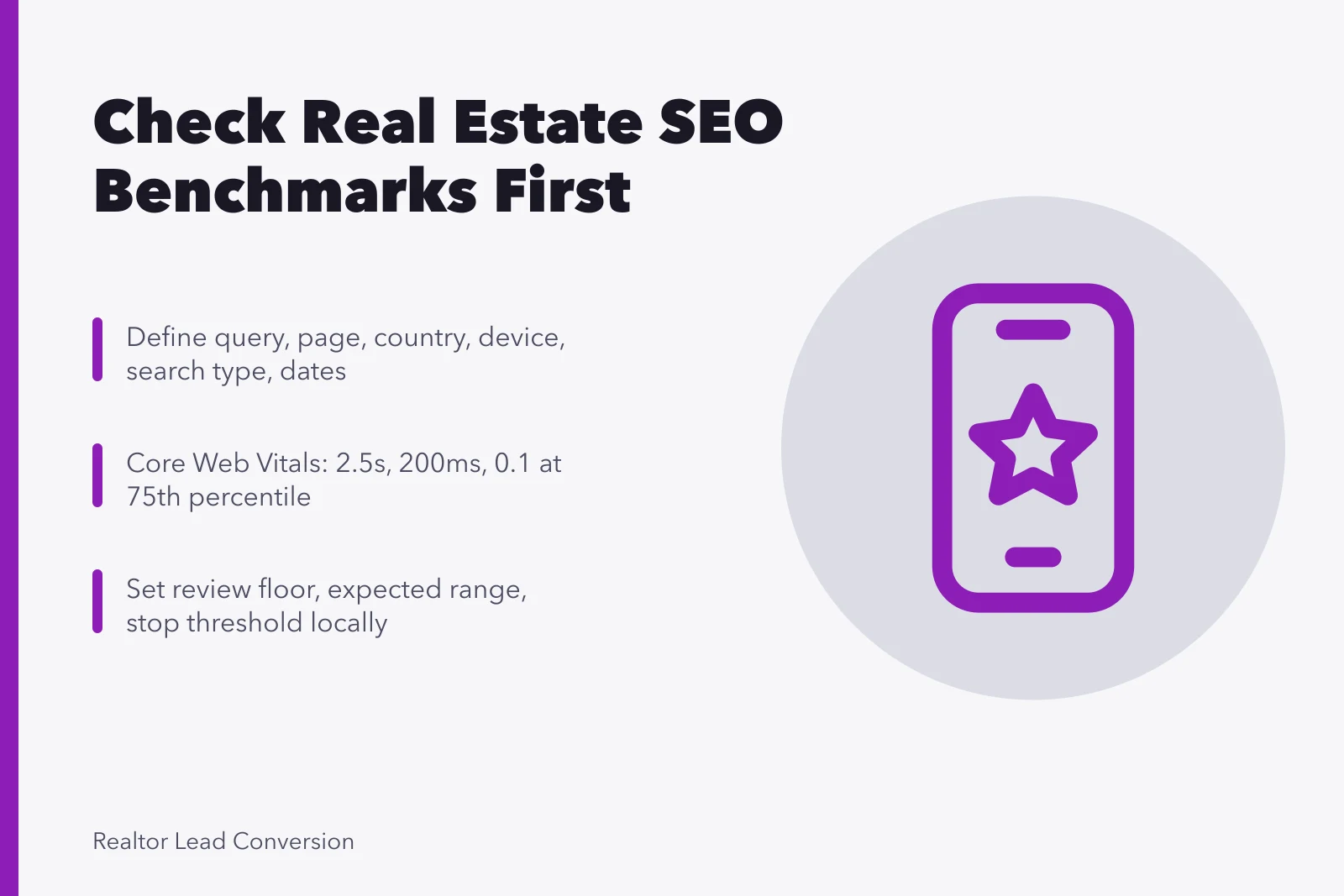
- Define query, page, country, device, search type, aggregation, and date before comparing search-performance numbers.
- Core Web Vitals are field experience measures with documented thresholds, not ranking, lead, or revenue guarantees.
- Use local baselines and decision ranges that include data quality, releases, inventory, market context, task success, and business capacity.
Real estate SEO benchmarks should answer a stated decision about a stable page and query group. Separate discovery, crawl, index, search appearance, visit, on-site task, qualified inquiry, agreement, and transaction layers. Do not merge them into one visibility score. Record the source, dimensions, period, definitions, exclusions, owner, and known gaps.
1. Read Search Console aggregation correctly
Google's Performance report data guide says Search Console can aggregate by property or page, and that counting impressions, clicks, click-through rate, and position differs between those views. Recent data can be preliminary.
Baseline Visibility Checklist
- Search type and query filters
- Page filters and country
- Device and date range
- Grouping and canonical behavior
- Data freshness and zeroes
When building a baseline, keep selected search type, query, page filters, country, and device visible, and also keep dates, grouping, canonical behavior, and freshness visible.
Use page groups that reflect a business system: offices, agent profiles, current listings, archived listings, seller services, buyer education, rentals, management services, research, or contact paths. Use query groups that reflect intent without exposing private information. Keep branded and nonbranded views distinct when the report supports them. Compare matched periods and retain zeroes and missing values honestly.
A group of agent profile pages and a group of current listings draw different queries from different people, so averaging them hides both. The group, not the whole site, is the unit that makes a benchmark readable.
2. Measure field experience separately
The web.dev article on Core Web Vitals thresholds identifies Largest Contentful Paint, Interaction to Next Paint, and Cumulative Layout Shift as field metrics for load experience, responsiveness, and visual stability. It lists good thresholds of 2.5 seconds, 200 milliseconds, and 0.1 at the 75th percentile.
Core Web Vitals Thresholds
- 2.5 secondsLargest Contentful Paint
- 200 millisecondsInteraction to Next Paint
- 0.1Cumulative Layout Shift
Those thresholds classify observed user experience. They do not guarantee indexing, ranking, conversion, or business results.
3. Build an evidence ladder
| Layer | Example measure | Do not infer |
|---|---|---|
| Technical | Indexable sample rate | Search visibility |
| Search | Impressions and clicks | Unique people or clients |
| Experience | Field performance and task success | Ranking cause |
| Business | Qualified inquiry and service outcome | SEO-only causation |
Set a review floor, expected range, and stop threshold from local evidence. Annotate template releases, redirects, migrations, outages, inventory shifts, season, market conditions, media changes, structured-data changes, consent updates, analytics revisions, and search-system updates. A rising click count can still be a bad outcome if pages are stale, users are misled, tasks fail, or the team cannot serve demand.
For a realtor, the layers closest to the money are the visit, the on-site task, the qualified inquiry, the appointment, and the agreement. Lead-side measures belong in the same record as the search numbers, kept separate from them instead of blended into one score. A benchmark that stops at impressions and clicks cannot say whether the team converts what it captures.
4. Benchmark record
- Decision, owner, page group, query group, search type, country, device, aggregation, and date range.
- Baseline, expected range, minimum evidence, segmentation, exclusions, data gaps, and quality checks.
- Technical release, market and inventory context, task outcomes, business capacity, risk signals, and next review.
5. Make the comparison reproducible
The GAO evaluation design guide connects evaluation questions with evidence needs and design choices. Apply that discipline to real estate SEO benchmarks; federal evaluation guidance does not make a local marketing result causal or transferable.
The NIST experimental design selection guidance begins design choice with the objective and practical constraints. It supports separating real estate SEO benchmarks reporting from controlled effect estimates, not turning observation into causation.
For real estate SEO benchmarks, keep the evidence record beside the decision so a reviewer can reproduce the reasoning without relying on memory.
Common questions
What is a good click-through rate?
There is no universal rate. Result type, query, brand familiarity, position, device, market, snippet, season, and aggregation differ. Use a matched local range.
Should average position be a primary target?
Treat it cautiously. It is an aggregated topmost position measure, not a fixed rank seen by every user. Pair it with meaningful impressions, clicks, page quality, and outcomes.
Do passing Core Web Vitals guarantee better rankings?
No. They describe field user-experience thresholds. Search eligibility, content, competition, many other signals, and user decisions remain separate.