Careers
Part of Getting Real Estate Marketing Strategy Right the First Time
The Real Estate Marketing Strategy Checklist That Catches What Audits Miss
real estate marketing strategy checklist for 2027 covers authority, fair access, claims, listings, contact permission, partners, measurement, and exit.
What to take away
- Complete the business boundary, authority, access, evidence, listing, media, channel, and account checks before release.
- Record contact permission and partner services at the level needed to review actual conduct, disclosures, value, and suppression.
- Launch only with named owners, decision ranges, complaint and correction routes, budget limits, exports, and stop rules.
A real estate marketing strategy checklist helps teams document decisions before a campaign reaches the public. It is not legal or brokerage advice. Adapt it to current jurisdiction, license, property type, transaction role, MLS, association, audience, and channel requirements with qualified fair-housing, privacy, accessibility, legal, brokerage, tax, employment, and industry reviewers.
Business boundary
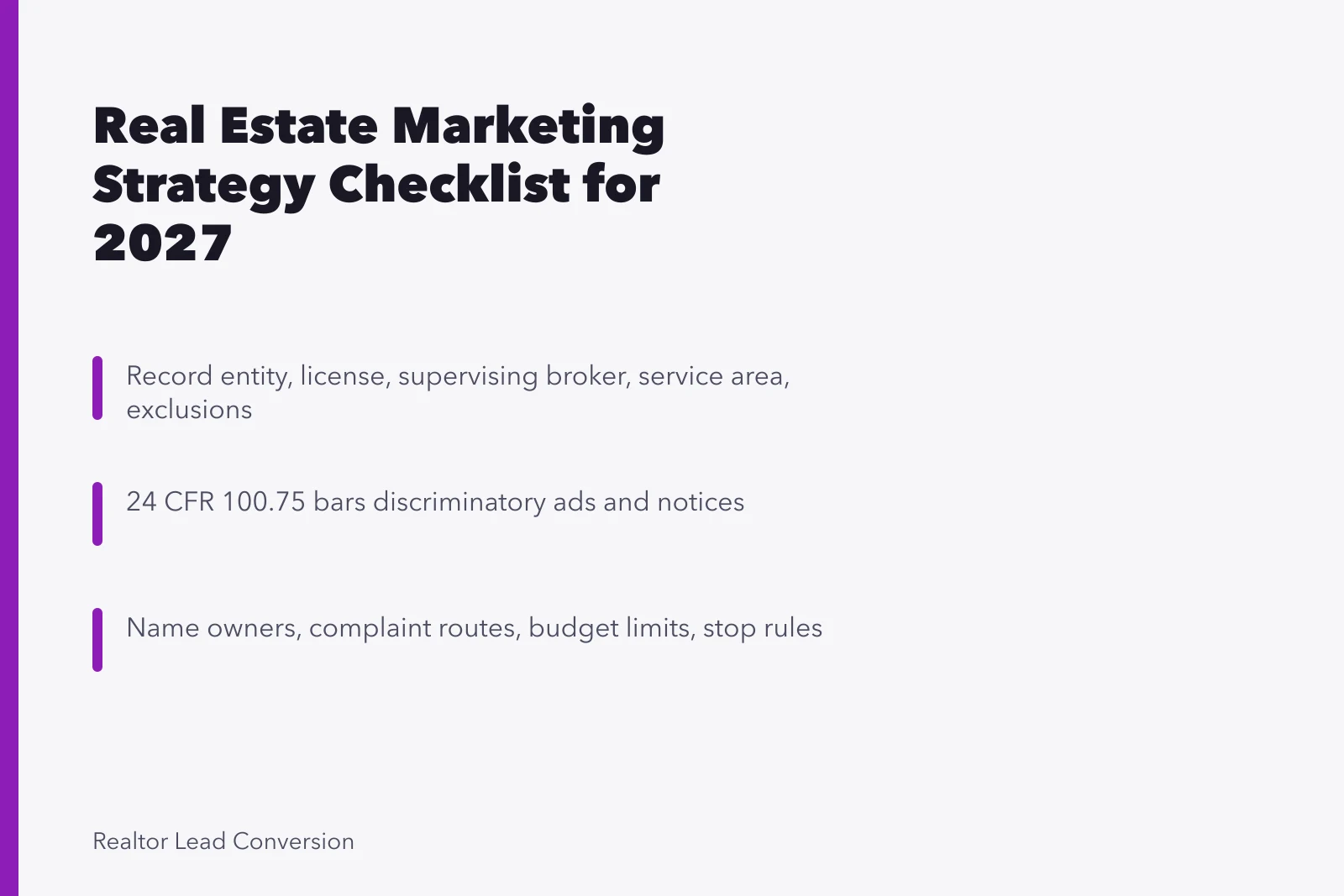
Record entity, license, supervising broker, service area, property types, transaction sides, languages, memberships, professional claims, approvers, and excluded work. Confirm required names, identifiers, and disclosures for each format.
Audience and fair housing
GovInfo's 2025 annual edition of 24 CFR 100.75 on discriminatory advertising says covered notices, statements, and ads may not indicate preference, limitation, or discrimination based on protected characteristics. It lists conduct that can violate the rule.
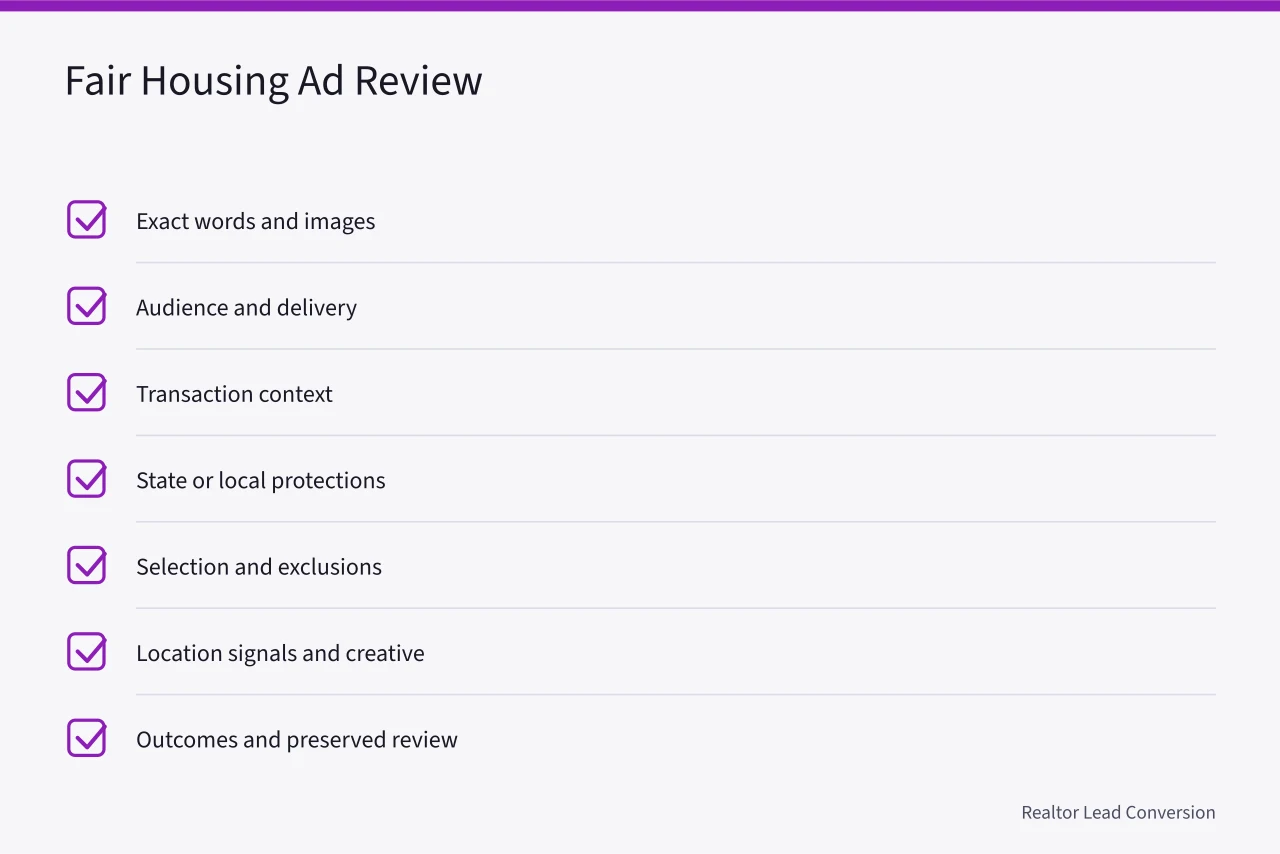
The PDF is an annual U.S. federal edition, not a complete global checklist. Check the current rule and review the exact words and images, audience, channel and delivery, transaction, and additional state or local protections.
Define a housing or business situation, decision, questions, barriers, and intended reach. Review selection, exclusions, location signals, creative, landing page, delivery, and outcomes for discriminatory statements, steering, denial of information, or unjustified effects. Preserve the review. Fair housing reviews of audience selection and delivery connect directly to the real estate marketing strategy mistakes that surface later during repair.
Evidence and offer
List every material market, service, property, performance, ranking, credential, and testimonial claim with source, date, geography, method, qualification, owner, approval, and expiry. Explain process, representation, negotiable elements, client duties, third parties, and limits without promising an outcome.
Listings and media
Name the authoritative record for price, status, features, dimensions, availability, open houses, disclosures, and syndication. Confirm photo, plan, video, music, drone, model, artwork, and editing rights. Label simulated or proposed conditions and provide accessible alternatives.
Channels and accounts
The FTC's Endorsement Guides questions and answers explain when endorsers and marketers should disclose a connection. They also explain why a platform tool may not always make that disclosure clear. The guidance covers U.S. advertising, not every review or jurisdiction.
For testimonials, creators, partners, and incentives, record the relationship, approval, placement, wording, and evidence a reasonable audience will actually see.
Assign a job, owner, budget, content, data, access, risk, measure, and exit to website, local profile, search, portal, email, social, print, events, partners, and paid media. Use company-controlled domains, profiles, analytics, billing, credentials, backups, and recovery. Six real estate marketing strategy examples show how channel jobs differ for sellers, buyers, rentals, and commercial work.
Contact and partners
Preserve source, request, notice, consent, permitted channels, time, owner, status, response, and suppression. Review calling, texting, email, recording, and privacy duties. Document partner service, value, payment, referral conduct, disclosure, data, invoices, monitoring, and RESPA analysis where relevant.
Measurement and launch
Define funnel stages, formulas, sources, windows, duplicates, costs, time, quality, complaints, opt-outs, corrections, and fair-housing signals. Set baseline, target range, maximum loss, capacity limit, and stop rule. Test mobile pages, forms, routing, listing updates, accessibility, disclosures, analytics, account recovery, corrections, withdrawal, data export, and campaign archive before launch. Schedule weekly operations, monthly evidence review, and quarterly portfolio decisions.
Prelaunch sign-off
| Area | Required record | Approver |
|---|---|---|
| Authority | Role, property, channel | Brokerage |
| Access | Audience and delivery review | Fair housing |
| Claims | Source and expiration | Subject owner |
| Contact | Request and suppression | Operations |
| Launch | Budget, range, stop rule | Business owner |
Record the gate result
The W3C Privacy Principles statement gives web-system designers shared privacy concepts and warns against shifting privacy work to individuals. Apply it to real estate marketing strategy checklist, then review the governing law and configuration.
The CISA software acquisition fact sheet covers development practice, supply-chain exposure, deployment, and vulnerability management. Add those government-acquisition questions to a real estate marketing strategy checklist review without treating them as local approval. A real estate marketing strategy development plan should treat those acquisition questions as inputs, not as local approval.
Common questions
Who should own the checklist?
One business owner should coordinate it, while qualified role, brokerage, legal, fair-housing, privacy, accessibility, finance, security, and channel reviewers approve relevant items.
Does a completed checklist prove compliance?
No. It is a decision record, not a legal opinion. Reviewers must examine the actual campaign, facts, jurisdiction, delivery, and later operating conduct.
When should the checklist be reopened?
Reopen it when the audience, offer, property facts, claim evidence, channel, partner, data use, technology, law, policy, owner, budget, or service capacity changes.