Strategy
Part of An Eight-Week Real Estate Lead Generation Pilot, Compared to Ad Hoc Outreach
Real Estate Lead Generation Trends: The Parts Worth Your Attention
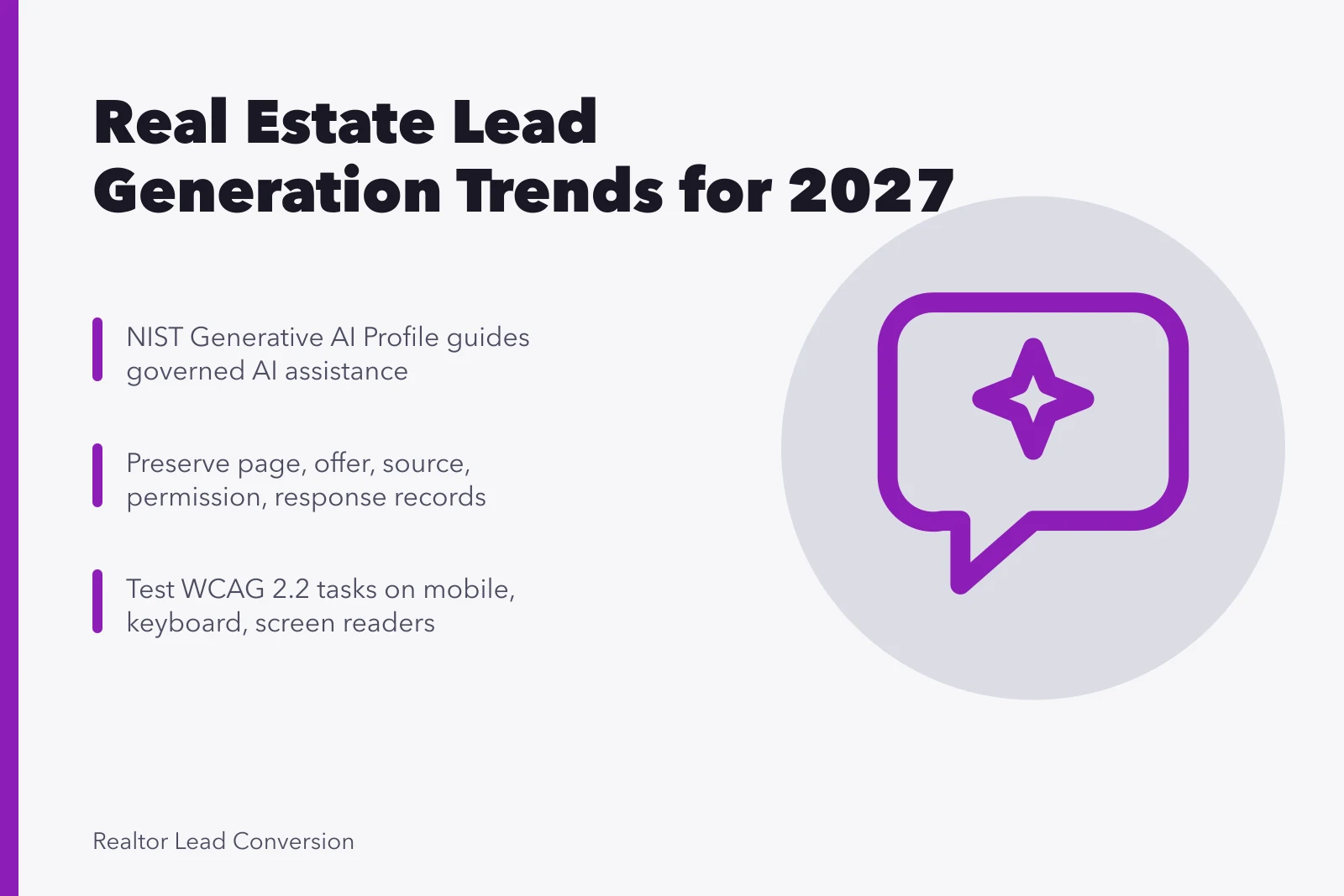
real estate lead generation trends for 2027 include governed AI assistance, accessible forms, first-party evidence, quality scoring, and operational resilience.
What to take away
- The useful 2027 shift is toward reviewable systems, not more automated volume.
- AI assistance, data boundaries, accessibility, source evidence, quality decisions, and resilience require named owners and tests.
Real estate lead generation trends for 2027 are better treated as planning scenarios than forecasts. Each trend below has an adoption question, evidence requirement, and failure mode. Validate it against the current market, role, platform, law, service capacity, and client behavior before changing a budget or workflow.
Public data points help. Typical paid search cost per lead in U.S. real estate runs about $20 to $80. Social media leads run about $10 to $50. Portal leads often run $100 to $500 or more when exclusive. These are typical ranges, not fixed benchmarks.
NAR's annual Member Profile and its technology survey report tool adoption by segment. Read the current edition for your market.
1. Governed AI assistance
Teams may use generative systems to draft variants, summarize inquiries, suggest routing, or support quality review. Keep humans accountable for housing access, claims, professional judgment, final messages, and adverse effects.
For example, a team using an AI draft for a listing inquiry can require a named agent to review fair-housing language and the final message before sending.
NIST's Generative AI Profile for the AI Risk Management Framework is a voluntary cross-sector companion resource. It flags risks specific to or worsened by generative AI, with suggested actions across govern, map, measure, and manage.
It is not a certification or real estate rule; use it to structure ownership, testing, incident learning, and risk decisions for a defined use. Apply current housing, privacy, advertising, and professional requirements separately.
2. Tighter first-party evidence
Teams will benefit from preserving the page, offer, source, notice, submitted request, permission, transfer, response, suppression, and final disposition in a controlled record. The aim is not to collect everything.
For example, a CRM handoff should log the page, offer, source, permission, and suppression status so a new agent can see why the lead exists.
3. Accessible conversion paths
Accessibility will move from a late compliance check into form, calendar, document, video, chat, and recovery design. Test real tasks on mobile, keyboard, zoom, screen readers, and error states. Provide a human alternative and avoid forcing a visitor through an inaccessible automated path to obtain basic property or service information.
W3C's Web Content Accessibility Guidelines 2.2 Recommendation defines testable success criteria under four accessibility principles and provides three conformance levels. WCAG conformance does not settle every legal duty or guarantee a real task works well.
Use the current technical criteria with user-centered testing, supported technology assumptions, documented exceptions, and prompt correction of blocked journeys. A real estate lead generation checklist turns those accessibility criteria into sign-off items before any campaign goes live.
4. Quality-aware lead decisions
Raw cost per lead will give way to a set of measures: valid source, permission evidence, acceptance, connection, service fit, appointment quality, complaints, access, response, full cost, and later outcomes. Keep the rules understandable and appealable. Do not let an opaque score decide who receives housing information or service without review.
5. Smaller channel portfolios
A business may prefer fewer channels with clear jobs, owned records, tested handoffs, and understandable costs. Concentration creates its own risk, so preserve exports and alternatives. The decision should follow observed service and quality evidence, not a blanket claim that first-party or owned media is always cheaper or safer.
For example, a team may cut paid social, keep Google Ads for high-intent searches, and route every lead into Follow Up Boss with a tested Zapier handoff.
6. Operational resilience as conversion work
Account recovery, queue coverage, integration alerts, consent and suppression continuity will become visible growth controls. Property updates, vendor exit, and human fallback will too.
A lead lost to an expired credential or absent owner is a service failure; test failure and recovery before scaling acquisition. A dated watchlist of real estate lead generation mistakes helps teams spot repeated failures before scaling.
A recovery drill: disable the CRM sync for one hour, confirm every new lead still gets a human response, then restore the sync and document the gap.
Trend review matrix
Trend Review Matrix
Trend
- AI assistance
- Use case, tests, owner, fallback
- First-party evidence
- Data map and retention
- Accessible paths
- Real task testing
- Quality decisions
- Defined rules and appeal
- Resilience
- Failure and recovery drill
Evidence before adoption
- AI assistance
- Unreviewed output or bias
- First-party evidence
- Excess collection
- Accessible paths
- Blocked user journey
- Quality decisions
- Opaque exclusion
- Resilience
- Silent service loss
Main failure
- AI assistance
- First-party evidence
- Accessible paths
- Quality decisions
- Resilience
| Trend | Evidence before adoption | Main failure |
|---|---|---|
| AI assistance | Use case, tests, owner, fallback | Unreviewed output or bias |
| First-party evidence | Data map and retention | Excess collection |
| Accessible paths | Real task testing | Blocked user journey |
| Quality decisions | Defined rules and appeal | Opaque exclusion |
| Resilience | Failure and recovery drill | Silent service loss |
Maintain a dated watchlist
Use the NIST AI RMF Playbook to assign one owner and one test for a single AI use case. Record the result.
The W3C Privacy Principles statement gives web-system designers shared privacy concepts and warns against shifting privacy work to individuals. Apply it to real estate lead generation trends, then review the governing law and configuration.
Common questions
Will AI replace real estate lead teams in 2027?
That is not established. Use AI only for defined tasks with human accountability, access review, evidence, testing, correction, and fallback appropriate to the risk.
Is first-party data automatically safer?
No. Collection, notice, permission, access, security, retention, sharing, correction, and deletion still require governance. Ownership does not excuse misuse.
Which trend should a small team prioritize?
Fix the weakest service control first. Clear definitions, source evidence, accessible capture, owned routing, suppression, and recovery usually support later technology choices.