Costs
Part of Real Estate SEO: A Practical Operating Framework
How to Improve Real Estate SEO Without Penalties
how to improve real estate SEO in 2027 starts with an evidence-based diagnosis, indexable pages, useful local content, clear architecture, and measured repairs.
What to take away
- Most "penalties" realtors report are technical faults, not punishments. Blocked crawling and stray noindex tags cost traffic the same way.
- Real penalties follow Google's spam policiesmass city pages, doorway pages, bought links, and markup that does not match the visible page.
- Answer one decision per page. A listing page carries facts and status. A neighborhood page carries what you know and a competitor cannot copy.
- Judge a repair on indexed URL count and qualified inquiries. Give it 60 to 90 days.
Clean the crawl and index faults before rewriting copy
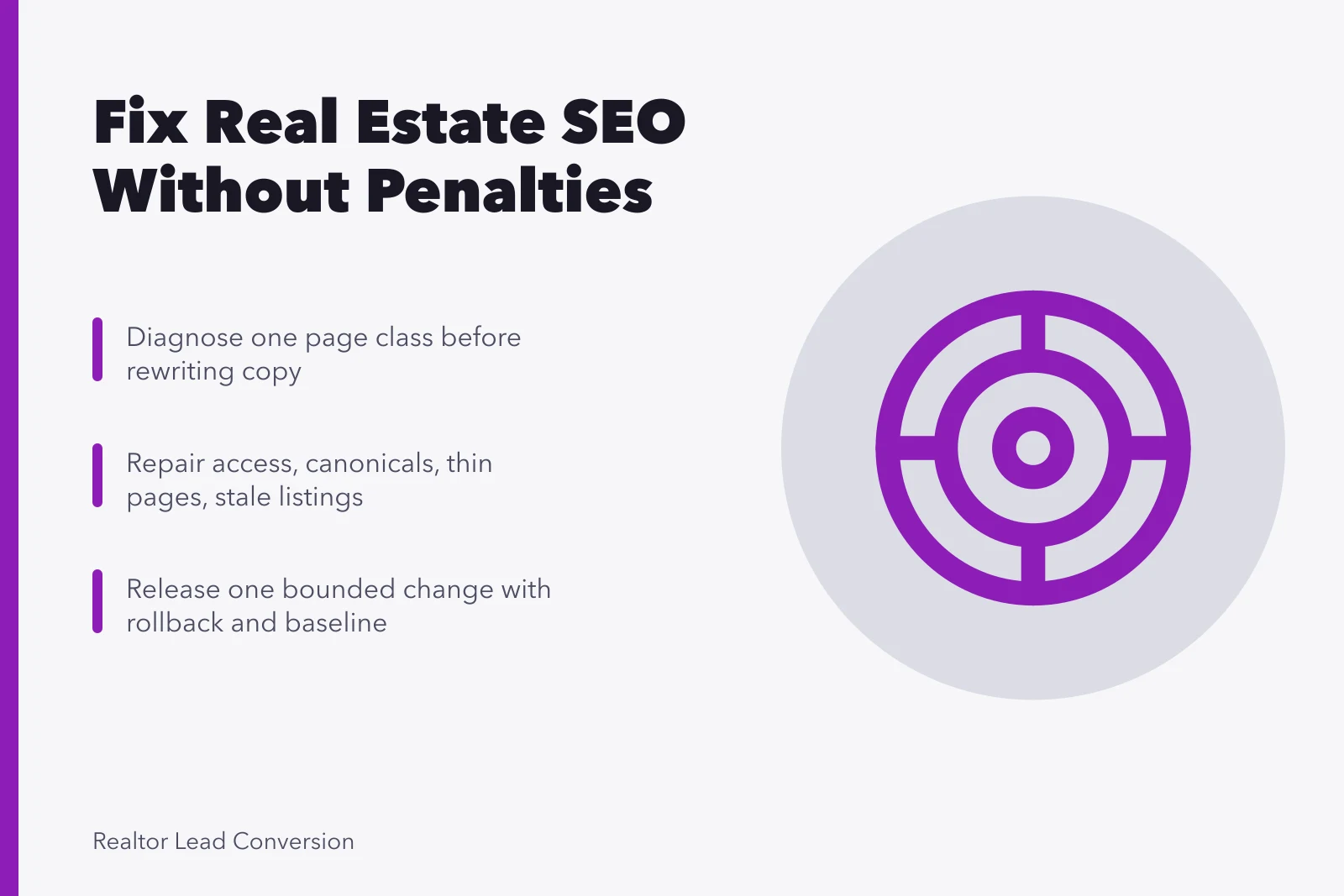
Open Google Search Console first. Check the Manual Actions and Security Issues reports, because a manual action makes every later content test meaningless. Then work the six checks in order.
Clean the crawl and index faults
- Confirm robots.txt does not block Googlebot and that no listing template carries an accidental noindex tag.
- Sample ten URLs across listing, neighborhood and agent templates. Compare the live HTML with the indexed version in the URL Inspection tool.
- Fix redirect chains and canonicals that point at the wrong variant of a filtered listing URL.
- Make sold, expired and withdrawn listings resolve to a useful page instead of a soft 404.
- Confirm status codes, then resubmit a sitemap whose URL count matches the number you intend to index.
- Standardize the title tag formatstreet or building, city, state, then the listing or agent name.
Sample live and indexed versions of real pages rather than trusting a sitewide health score.
Common technical defects to fix
- Unintended noindex rules
- Blocked rendering resources
- Redirect chains
- Broken canonicals
- Duplicate parameters
- Orphaned pages
- Wrong status codes
- Inaccessible navigation
Indexing quirks come up often enough to deserve their own read. Common real estate SEO questions collects the ones realtors raise most in client calls.
What actually triggers a Google penalty
Google separates technical requirements, spam policies and key practices. Meeting the technical requirements does not guarantee indexing. Breaking a spam policy can trigger a manual action, and recovery takes longer than the traffic it gained.
| Trigger | How it looks on a realtor site | The fix |
|---|---|---|
| Scaled content abuse | Hundreds of city pages built from one template | Publish only markets you serve and can describe |
| Doorway pages | A page that exists only to funnel visitors to an office page | Give each location a real task, address and contact route |
| Link spam | Paid links from regional directories and guest posts | Remove or disavow them, then stop buying |
| Structured data spam | RealEstateListing markup for homes you do not represent | Keep markup matching the visible page |
| Cloaking | Different content served to Googlebot | Serve the same page to every visitor |
Manual actions appear in Search Console. Algorithmic demotions appear nowhere, so offices blame a penalty for what is a quality gap.
Most of those triggers come from a handful of habits that repeat across brokerages. Real estate lead generation mistakes covers the same habits from the lead side, which is where the cost lands.
Example: a neighborhood page that earns its place
Weak: "Homes for Sale in Frisco, TX. We are your Frisco experts. Contact us today." Strong: "Frisco: what a mid-range budget buys in three named subdivisions, which school boundaries shift street by street, and the HOA fee ranges we see most often."
The strong version holds facts a buyer cannot get from a template. That is the line between a neighborhood page and a doorway page. Pages explaining the buying process can link to HUD's homebuying portal rather than rewriting it badly.
Keep listing pages accurate and indexed
The same listing appears on the MLS, the broker site, your own site and several portals. Pick one canonical page per property and let the others point at it instead of competing.
Update status from a single controlled source. When a home goes pending or sold, change the page text and the markup together. A sold page that still reads active teaches buyers to distrust every other page you publish.
Lead follow-up decides whether the ranking work pays for itself. Best practices for real estate lead generation covers the gap between form submission and the first call.
Phone follow-up carries its own rules. The FTC guidance on the Telemarketing Sales Rule sets out the limits on calling numbers on the Do Not Call list.
Measure the repair and set a decision window
| Signal | Where to read it | Check at |
|---|---|---|
| Indexed URL count | Search Console Pages report | 14 days |
| Impressions and clicks by page class | Search Console Performance report | 28 days |
| Qualified inquiries | The source field in your CRM | 60 to 90 days |
| Listing fact corrections | Your own error log | Weekly |
Season and inventory move these numbers more than most on-page edits do. Note the month, the active inventory and any outage before you call a change a success.
Two rules keep the window honest. Do not change templates, URLs and copy in one release unless a migration forces it. Do not judge at seven days, when indexed versions still lag.
Annotate the release date and the template version in your analytics so a later spike has an explainable cause. Real estate marketing analytics shows how to keep a before-and-after comparison honest when the market shifts underneath it.
Canada adds a privacy layer
Marketing to buyers in Canada brings privacy duties. PIPEDA governs how you collect, use and store lead data, including text message threads. The PIPEDA overview is the place to start.
A chat widget or capture form added during an SEO repair creates an obligation, not just a conversion win. Store the consent record beside the lead it belongs to.