Operations
Part of An Eight-Week Real Estate Lead Generation Pilot, Compared to Ad Hoc Outreach
Best Practices Checklist for Real Estate Lead Generation, From Form to Follow-Up
real estate lead generation best practices in 2027 center on minimal data, accessible forms, explicit routing, prompt service, source evidence, and clear learning.
What to take away
- Ask only what the next step needsname, one contact channel, property or area, timeline, consent.
- Set a first-reply target of five minutes during coverage hours and measure the median.
- Keep a written consent record per channel. The TCPA, CAN-SPAM, state privacy laws and PIPEDA treat calls, texts and email differently.
- Give every lead one named owner, backup cover, an escalation path and a final disposition.
- Report the failuresduplicates, misroutes, opt-outs, unserved requests.
Six steps run in one order: capture, consent, route, reply, measure, correct. Each step needs an owner and a piece of evidence. A real estate lead generation program that tracks all six can compare its own results across eight weeks rather than judging one campaign.
Capture the minimum in a usable form
A minimal real estate lead form carries:
Capture the minimum
- Name
- One contact channel, with text permission as a separate unchecked box
- Property address, neighborhood or search area
- Timelinenow, one to three months, six months, browsing
- Consent statement with the exact wording shown to the user
- Optional free-text note
Two values belong behind the scenes, not on the form: source and page version. Keep both in hidden fields so the routing rule and the consent record stay attached to the lead. That pairing lets a later audit reconstruct which page produced the lead.
Label every field visibly. Mark required fields in text, accept common phone formats, confirm what happens next, and offer a phone or email alternative. The W3C form input validation tutorial notes that client-side validation alone does not make a form secure, so test the server side too.
The real estate lead generation checklist covers the pre-launch pass that keeps these rules from drifting after the page goes live.
Consent rules that govern follow-up
A form submission is not blanket permission. In the United States, the TCPA governs calls and texts to consumers, including automated dialing, and the National Do Not Call Registry applies to live sales calls. The FTC's Telemarketing Sales Rule guidance explains the conduct rules that agents and their vendors must follow.
Email sits under CAN-SPAM, which requires accurate headers and a working unsubscribe. California, Colorado and Virginia give residents rights to see, delete or limit the use of their data. Rights and deadlines differ by state. Keep suppression lists separate per channel, because an email opt-out does not stop a call.
In Canada, PIPEDA governs commercial handling of personal information. The Office of the Privacy Commissioner's PIPEDA overview sets out consent and retention duties, and CASL adds separate rules for commercial electronic messages. Segment consent by country when both markets share one CRM.
Store the notice version, timestamp, source and consent wording with the lead record. Without it, a later dispute is one person's word against another.
Route and reply inside five minutes
Route and reply
- Log the lead with source, timestamp and consent record.
- Notify the assigned agent by app push or SMS, with a named backup for absences.
- Reply within five minutes during coverage hours, on the channel the person chose.
- After three attempts across two days, move the lead to a scheduled nurture sequence.
- Record the final dispositionappointment, not ready, wrong area, opted out, unreachable.
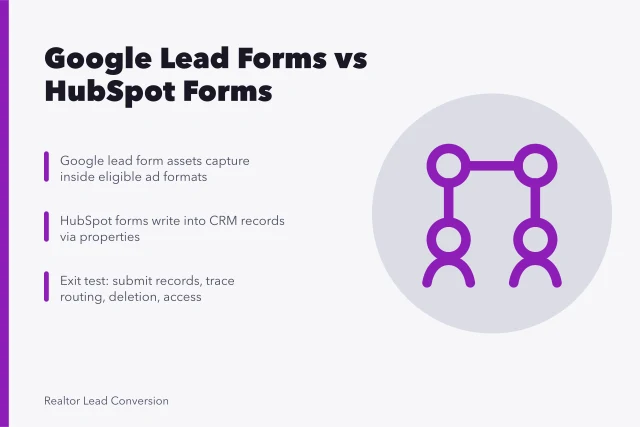
Five minutes is an internal target, not a published industry constant. Set it, measure the median and revise it when the data justifies a change. Capture often starts on Google Forms or Typeform. A CRM such as HubSpot or Salesforce handles routing, permissions and timestamps. Real estate lead generation tools compares the two on cost and follow-up.
A lead with no owner is a lead with no reply.
Example: one bounded response-time test
Hypothesis: replying within five minutes books more appointments than replying the same day. Run it for two weeks on new leads only, alternating by day of arrival. Stop the test if the fast arm misses the five-minute window on more than a quarter of leads, or if complaints rise.
Write the hypothesis, sample, window and stop rule before the first lead arrives. Then compare appointment-set rates and reply times side by side.
Measure without hiding the failures
Measure without hiding failures
| What to report | Evidence source | Failure signal |
|---|---|---|
| Completion rate by field | Form analytics | Drop-off at one field |
| First-reply time | CRM timestamps | Median over target |
| Routing accuracy | Queue and exception log | Leads with no owner |
| Consent record | Stored notice and timestamp | Missing or mismatched |
| Opt-outs | Suppression list | Contact after opt-out |
Keep invalid, duplicate, suppressed and unreachable leads in the report. A funnel that counts only wins hides the cause of the loss. Compare against your own prior periods before borrowing an outside number, and read real estate lead generation benchmarks for why ranges beat single figures.