Careers
Part of Real Estate SEO: A Practical Operating Framework
4 Real Estate SEO Mistakes Worth Fixing Before They Cost a Sale
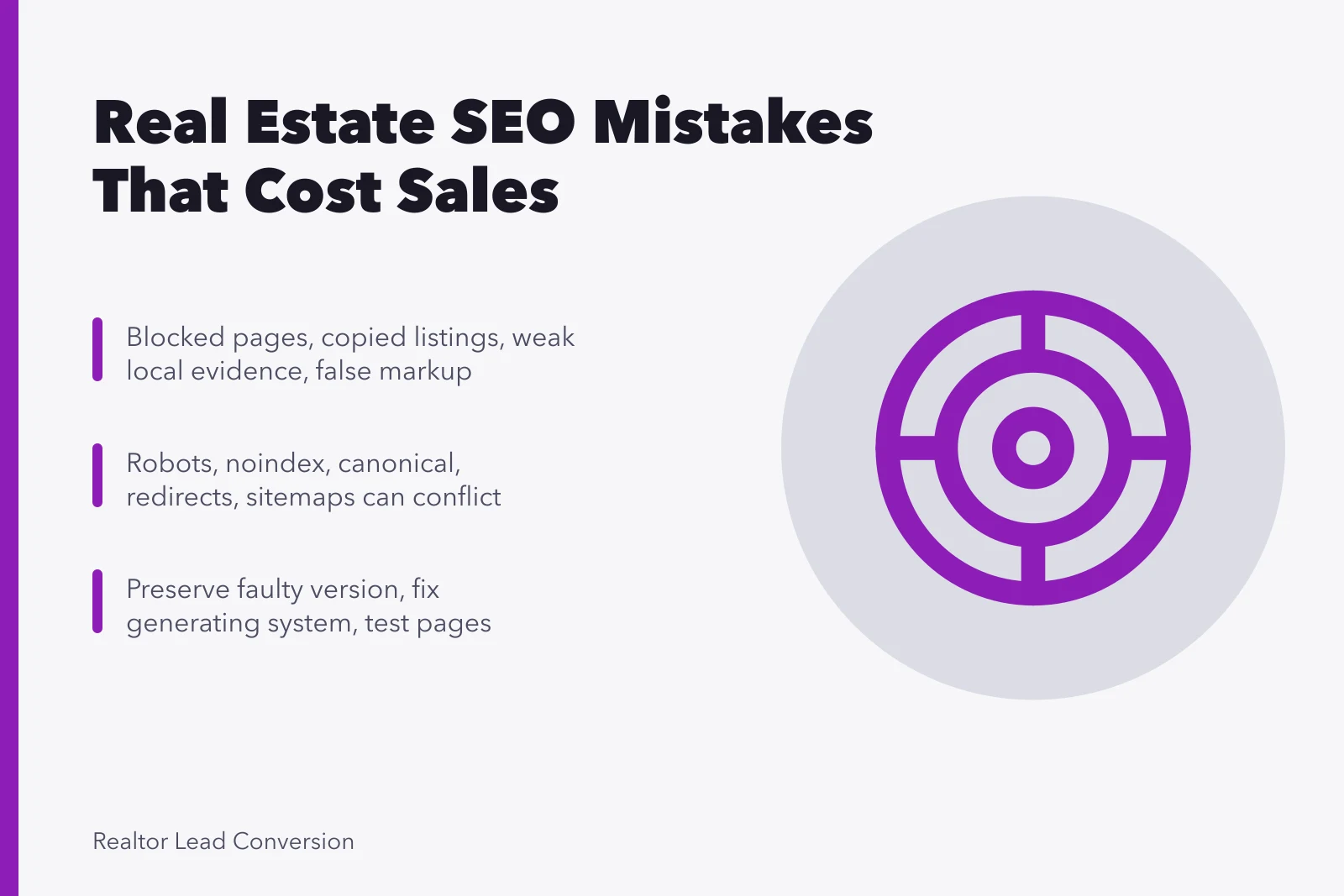
real estate SEO mistakes in 2027 include blocked pages, copied listings, weak local evidence, false markup, unsafe claims, poor images, and unowned website changes.
What to take away
- Four real estate SEO mistakes cost sales fastestthin or invented local pages, ranking manipulation, stale listing facts, and crawl or index conflicts no one owns.
- Each one has a free checkGoogle Search Console, Bing Webmaster Tools, Google's Rich Results Test, the Schema Markup Validator, and a crawler such as Screaming Frog SEO Spider, which is free up to 500 URLs.
- Correct the live exposure, preserve the faulty version, identify affected page classes, then repair the system that generated them.
Real estate SEO mistakes can misstate availability, create discriminatory signals, and expose private information.
They also multiply duplicate pages, block important content, and distort reporting. Review the actual role, source data, and page template before a sitewide change. Check the search guidance, platform rules, and current legal duties too.
- Exposecheck the live page in Google Search Console, a crawler, or the Rich Results Test.
- Preservesave the URL, rendered output, headers, and template version before any change.
- Classifygroup affected pages by template, source feed, or status rule.
- Repairfix the system that generated the pages, then recrawl and verify.
Mistake 1: invented local pages
Mistake 1 is thin local content: copied or lightly rewritten listing, city, neighborhood, or service pages, plus fictional office and practitioner pages. Google's web search spam policies cover doorway abuse, scaled content abuse, and scraping.
A typical doorway pattern is a set of pages at /homes-for-sale-[city]-[zip] that share one template and swap only the city and ZIP.
Fix it with real data. Give each neighborhood or office page something only that place has: a median sale price, a school district, a commute time, or an HOA fee range. Google Search Console's Pages report shows which URLs Google indexed, crawled, or left undiscovered.
Mistake 2: ranking manipulation
Mistake 2 is manipulation: place names, property terms, or AI-oriented phrases stuffed into headings, hidden text, or markup, plus bought links, artificial link networks, and paid placement trades.
A bought link example is a sitewide footer link from an unrelated directory to the listing page.
Fix it by removing the mechanisms, not the words. Search Console's Links report lists the domains linking to a property page and the anchor text they use. Disavowing is rarely the right first move; deleting a bought link matters more.
Google's current web search spam policies list practices that can lower ranking or omit pages: cloaking, doorway abuse, expired-domain abuse, hacked content, hidden text. Other practices: keyword stuffing, link spam, scaled content abuse, scraping, sneaky redirects.
Misleading functionality counts too. These are Google policies, not a complete legal code. Use them to inspect production behavior and remove manipulative systems, not to chase isolated wording changes.
HUD's Fair Housing Act advertising guidance covers listing text and ad targeting, and it applies alongside Google's rules.
Mistake 3: stale listing facts
Mistake 3 is stale property information. Sold, leased, withdrawn, expired, or repriced pages can still claim availability, and corrected pages often keep the old wording. Structured data makes it worse when the markup is stale, invisible, inapplicable, or generated from a source no one reconciles.
A stale Sold listing example is a property page that still says Active and shows the old list price weeks after the MLS changed the status to Sold.
Fix it with a status trigger. MLS status changes such as Active, Pending, Sold, Expired, and Withdrawn should publish or unpublish the page. Schema.org's RealEstateListing type should match what a visitor sees, and Google's structured data guidelines require that match.
The Rich Results Test and the Schema Markup Validator check that markup for free. Keep one source of truth for status, price, and square footage. Portals such as Zillow, Redfin, and Realtor.com republish syndicated listing text, so the source fields matter.
Mistake 4: crawl or index conflicts
Mistake 4 is a crawl, index, or canonical conflict. Pages blocked in robots.txt, noindex set through a shared template, an X-Robots-Tag on a PDF, and canonicals pointing at a different URL than the sitemap all send mixed signals.
A conflicting canonical example is a page whose canonical tag points to the https://www version while the sitemap lists the non-www URL.
Fix it by testing what a crawler actually receives. Google's robots meta tag and X-Robots-Tag specifications explain page-level and text-level controls, including noindex and snippet rules. A crawler must be allowed to fetch a page to read its meta directives, and a sitemap does not override them.
Apply the source to the exact crawler and file type, inspect delivered headers and HTML, and test conflicting rules before release. Search Console's robots.txt report and URL Inspection tool show which Googlebot resources were blocked and which URL version Google indexed. Bing Webmaster Tools has its own robots.txt tester.
PageSpeed Insights flags CSS or JavaScript files blocked from Googlebot, and it reports Core Web Vitals thresholds of 2.5 seconds for LCP, 200 milliseconds for INP, and 0.1 for CLS.
A stacked release compounds any of this. Changing URLs, templates, hosting, analytics, and navigation on the same day, with no baseline, test plan, or rollback, turns one bug into a sitewide outage.
Crawl and Indexing Checks
- Test robots.txt for blocked rendering resources
- Inspect noindex and conflicting robots directives
- Align canonicals, navigation, redirects, sitemaps
- Reconcile structured data with visible content
- Stage URL, template, hosting, analytics changes
Fix table for the four mistakes
| Failure | Immediate action | System repair |
|---|---|---|
| Stale or unsupported listing facts | Correct availability and claims | Status-triggered publishing |
| Thin, copied, or invented local pages | Pause thin variants | Page-class value gate |
| Keyword stuffing or bought links | Remove the manipulative copy and links | Content and link review |
| Wrong noindex or blocked resource | Restore the intended directive | Template test |
| Signal conflict across canonical, redirect, sitemap | Choose the intended URL | Release checklist |
Preserve the affected URL, rendered output, headers, and template version before correction. Save the source fields, deployment record, and search evidence too.
Test representative pages, not only one example. Monitor the fix through recrawl and index evidence, but do not promise a return to a prior position. Record the cause and the owner who prevents a repeat.
Prove the correction
The GAO data reliability guide treats reliability as fitness for an intended use and requires documented assessment. Use that test for real estate SEO mistakes; the federal guide does not certify the local data.
The FTC advertising substantiation policy requires a reasonable basis before objective advertising claims are disseminated. Apply that U.S. rule to public performance claims on real estate SEO pages, and keep the evidence for the facts you state.
Common questions
What should be fixed first?
Fix inaccurate or harmful public information first, along with exposed data and unsafe access signals. Then handle security issues and sitewide crawling or indexing failures, ahead of cosmetic optimization.
Can a sitemap cancel a noindex rule?
Do not assume so. Sitemaps, crawling controls, index directives, canonicals, and redirects have different functions. Make the intended signals coherent and test them.
Should every duplicate page be redirected?
No universal action fits all cases. Determine the useful canonical page, user need, link and traffic path, and status first. Then weigh privacy and technical behavior before consolidating, redirecting, or removing.