Reviews
Part of Real Estate SEO: A Practical Operating Framework
Which Real Estate SEO Questions Come Up Most
common real estate SEO questions cover crawling, indexing, rankings, useful pages, duplicate listings, structured data, measurement, timing, and ownership.
What to take away
- Crawling, indexing, serving, visits, inquiries, and transactions are different stages with different evidence.
- No tool, markup type, sitemap, or vendor can guarantee that a page will be indexed or ranked.
- Real estate pages need current facts, clear ownership, useful decisions, and a defined end state when listings or services change.
Common real estate SEO questions often mix technical access with business results. Start by naming the stage being discussed and the evidence available.
Which questions come up most
This order is a typical pattern from realtor threads, not a measured survey.
- Which pages are indexed?
- Why is a listing missing?
- Does a sitemap guarantee indexing?
- Do city pages help local visibility?
- Does structured data help rankings?
- How often should SEO be reviewed?
What is the difference between crawling and indexing?
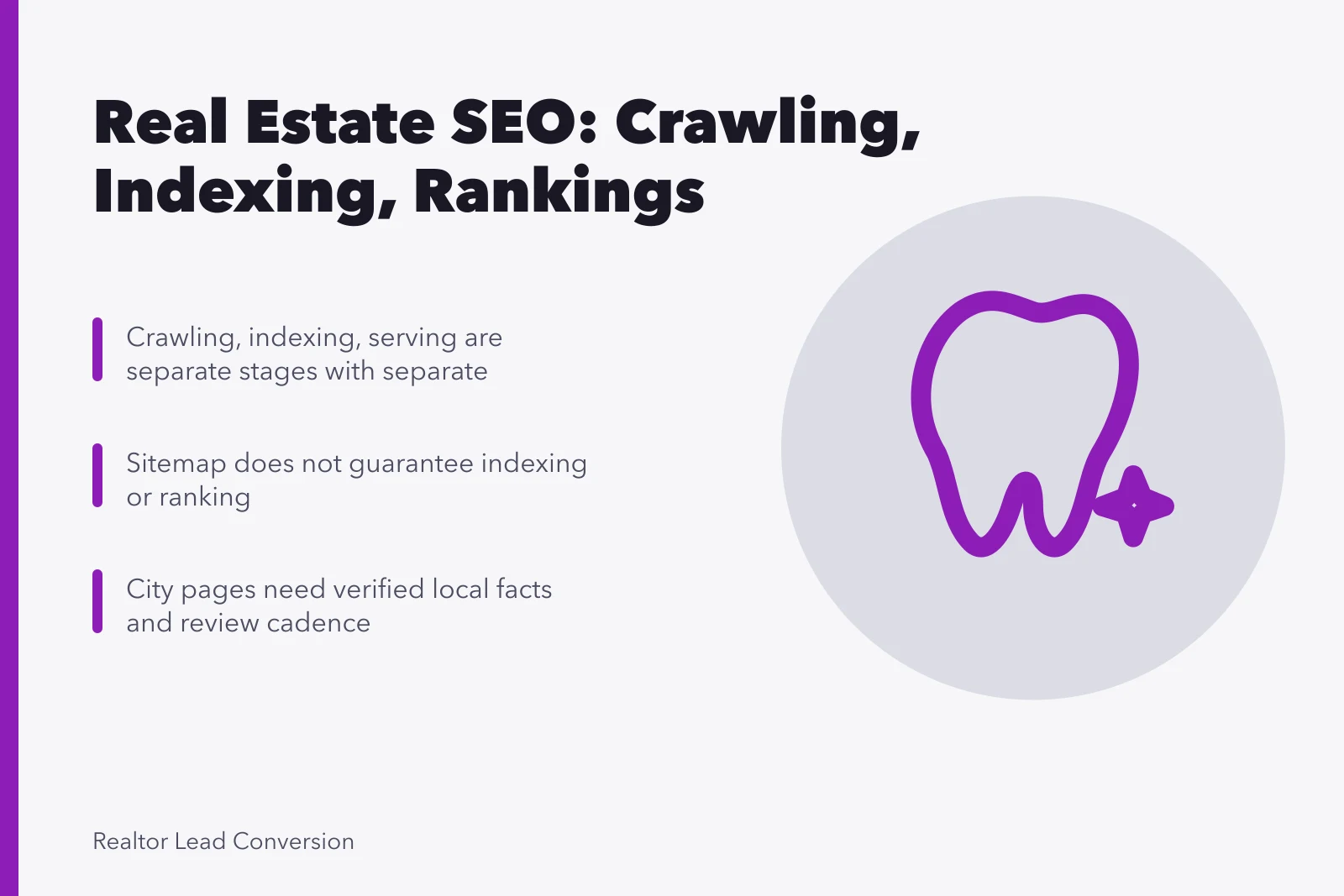
Google's in-depth guide to how Search works separates crawling, indexing, and serving. It says web crawlers discover and download pages, indexing analyzes content and signals, and serving returns results for a query.
Crawling, Indexing, Serving Stages
- Crawling: discover and download pages
- Indexing: analyze content and signals
- Serving: return results for a query
- No guarantee of crawling, indexing, or serving
- Diagnose missing URL by stage
Use these stages to diagnose a missing URL instead of calling every absence a ranking problem. An IDX detail page can be crawled and stored yet left out of serving.
Does a sitemap guarantee indexing?
No. A sitemap can help a search engine discover selected URLs and related information, but it does not replace useful pages, crawl access, valid responses, consistent canonical signals, or quality review. Keep only canonical, intended, current URLs in the file and reconcile additions, removals, last-modified values, and errors with the publishing system.
When new MLS listings go up, the sitemap should add them and drop the sold ones.
Why is an active listing missing from search?
Check whether the final URL is public, returns the intended status, renders its main content, permits crawling and indexing, appears in navigation or a sitemap, declares a coherent canonical, and contains distinct current facts. Then inspect platform reports and allow for processing. A technically eligible page may still not be selected for a query.
Active Listing Eligibility Checks
- Final URL is public
- Returns intended status
- Renders main content
- Permits crawling and indexing
- Appears in navigation or sitemap
- Declares coherent canonical
- Contains distinct current facts
Google's URL Inspection tool documentation says it shows Google's indexed version of a specific page and can test whether a live URL might be indexable.
Compare indexed and live evidence, rendered output, canonical selection, resources, and later status. Do not treat one green result as completion. An office page can pass a live test while the IDX pages beneath it stay out.
Do city pages help local visibility?
Publish a city or service-area page only when it serves a distinct decision. It needs verified local facts, real service capability, accountable maintenance, and useful material beyond a swapped place name. Consolidate thin variants.
Real office pages and service-area explanations may require different identity, address, hours, eligibility, and contact treatment. A documented review cadence for city pages belongs in any real estate marketing strategy checklist.
A brokerage with one office in Boise needs one page per town it serves.
Log SEO decisions: a realtor checklist
Log SEO decisions
- Write the question and the page or template it concerns.
- List the evidence checked, its source, and the date.
- Assign the fix to one person and set a review date.
- Record the end state for sold, expired, or withdrawn listings.
Evidence discipline from other fields
The GAO evaluation design guide connects evaluation questions with evidence needs and design choices. Apply that discipline to common real estate SEO questions; federal evaluation guidance does not make a local marketing result causal or transferable.
The W3C Privacy Principles statement gives web-system designers shared privacy concepts and warns against shifting privacy work to individuals. Apply it to common real estate SEO questions, then review the governing law and configuration.
Summary of the answers: question and evidence map
Summary of the answers
| Question | Evidence to inspect | What it cannot prove |
|---|---|---|
| Discovered? | Links and sitemap | Crawled or indexed |
| Indexable? | Response, render, directives | Will be indexed |
| Visible? | Query and page reports | Business outcome |
| Useful? | Task and content review | Guaranteed ranking |
Common questions
Should sold listings be deleted?
Choose an accurate end state based on ongoing user value, rights, privacy, platform rules, replacement quality, and search behavior. Do not leave a stale availability claim. A sold listing can stay live with a Sold note and links to similar homes.
Does structured data improve rankings?
Valid, accurate markup can help eligible systems understand content and support search features. A feature or a position depends on other factors. Markup on an IDX detail page helps systems read price and address.
How often should SEO be reviewed?
Monitor failures continuously, review fast-changing listing and office facts when they change, and evaluate durable content and technical controls on a documented cadence. Check sold status on IDX pages weekly, and office hours quarterly.