Operations
Part of Real Estate SEO: A Practical Operating Framework
6 Things a Real Estate SEO Checklist Has to Cover
real estate SEO checklist: six things to cover, from fair-housing compliance and local presence to crawl control, listing schema, and lead measurement.
What to take away
- Review one page class from source data through published HTML, search access, user task, measurement, correction, and retirement.
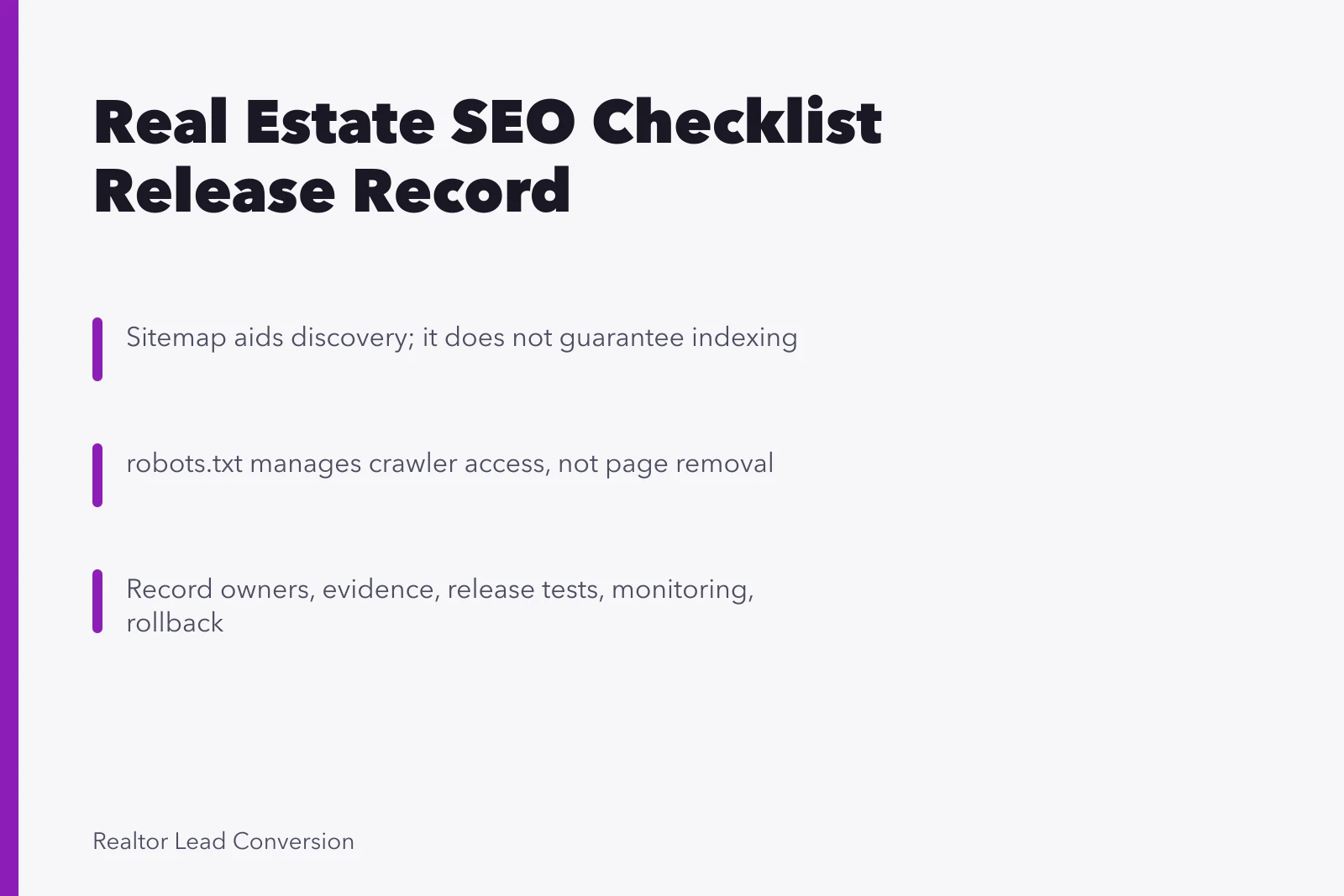
- A sitemap is a discovery aid and robots.txt manages crawler access; neither guarantees indexing.
- Record owners, evidence, exceptions, release tests, monitoring, and rollback before changing a template or large URL set.
Real estate SEO checklist turns a site review into an accountable release record. Mark each item complete, blocked, not applicable, or requiring qualified review. Attach the exact URL sample, page class, source data, rendered evidence, reviewer, date, decision, and follow-up. Reopen the checklist whenever the site, market, property state, platform, or rule changes.
The checklist covers six things:
- Purpose, facts, and page ownership.
- Local presence, citations, and reviews.
- Discovery and crawl control.
- Rendered page and experience.
- Listing and agent structured data.
- Measurement, lead conversion, and release.
1. Purpose, facts, and page ownership
- Page purpose.Pass: one client decision, one named company, office, practitioner, or property. Fail: two pages target the same decision.
- Fact source.Pass: authorized sources, a named owner, update event, and correction route. Fail: no owner.
- Copy and schema.Pass: titles, headings, claims, media, calls to action, and structured data match the visible facts. Fail: schema states a price or status the page hides.
- Fair housing and license display.Pass: advertising and listing language follow the federal Fair Housing Act and HUD guidance, plus state and local rules, and every agent or office page shows the license number its state real estate licensing board issued. Fail: a protected-class preference, a steering phrase, or a missing license line.
2. Local presence, citations, and reviews
- Google Business Profile.Pass: the office or agent profile is claimed, its name, address, and phone match the site, its categories and service area fit the market, and the photos are current. Fail: an unclaimed profile or an address that does not match the site.
- Local pack and near-me queries.Pass: the profile points to the right location page, and that page carries the office address, hours, and service area. Fail: every branch sends the visitor to the home page.
- NAP consistency.Pass: name, address, and phone are identical in the site footer, on the contact page, in the Google Business Profile, and in the major directories and brokerage feeds. Fail: an old office address or a tracking number that replaces the main line on every page.
- Reviews and follow-up.Pass: profiles collect and answer reviews, and a follow-up email or text goes out after every form submission or showing request. Fail: form leads that never get a reply.
3. Discovery and crawl control
- Sitemap coverage.Pass: every indexable URL in the class listed, 200 response. Fail: a live URL missing.
- Sitemap accuracy.Pass: canonical, indexable URLs only, matching rendered canonicals. Fail: blocked, redirected, or noindex URLs listed.
- Submission.Pass: Search Console shows the sitemap submitted, recently read, no errors. Fail: a stale last read.
Sitemap verification steps
- Include intended canonical URLs
- Verify generated locations
- Check last-modified values
- Remove retired items
- Check processing errors
- Keep pages reachable via navigation
Google's robots.txt intro says the file tells crawlers which URLs they can access and mainly manages crawling traffic, not keeping a page out of Google. A disallowed URL can still be indexed without a description if found elsewhere.
- Robots.txt syntax.Pass: 200 at the domain root, valid user-agent groups, intended paths only. Fail: a stray "Disallow: /".
- Index directives.Pass: noindex, nofollow, canonical, and hreflang agree with the page's search role. Fail: a canonical to a redirect or a conflicting noindex.
- IDX and MLS feeds.Pass: feed pages indexable only where license and display rules allow, each keeping required attribution. Fail: duplicates, missing attribution, or forbidden content.
Crawler control tests
- Test exact file at site root
- Check user-agent groups
- Check paths and wildcards
- Test generated environments
- Test noindex interaction
- Test authentication interaction
4. Rendered page and experience
- Status and rendering.Pass: final URL 200, primary content renders without login, stable canonicals, no broken loops. Fail: client-side data the crawler cannot render.
- Task completion.Pass: links, forms, errors, focus, keyboard use, zoom, mobile layout, and assistive use let a user finish. Fail: a form or focus state that blocks completion.
- Images.Pass: authorized sources, accurate context, purpose-based alt text, sized and responsive delivery. Fail: a stock photo that implies a property it does not show.
5. Listing and agent structured data
- Listing markup.Pass: property detail pages carry RealEstateListing and Offer structured data for the same price, status, and availability the page shows. Fail: markup that states a price or a sold status the page hides.
- Agent and office markup.Pass: agent bio and office pages use RealEstateAgent and Organization or LocalBusiness markup that names the same brokerage, license number, address, and phone shown on the page. Fail: markup naming a brokerage the page does not show.
- Breadcrumbs and search result pages.Pass: BreadcrumbList markup matches the visible path, and search result pages carry no listing markup of their own. Fail: the same listing markup repeated across templates.
6. Measurement, lead conversion, and release
| Gate | Evidence | Stop if |
|---|---|---|
| Content | Sources and fact check | Claim or status is wrong |
| Technical | Fetch, render, directives, canonical | Intent is unclear |
| Experience | Task and accessibility tests | User is blocked |
| Release | Sample, monitor, rollback | Owner or recovery is missing |
- Query groups.Brand, city plus "homes for sale", neighborhood, property type, agent name, and near-me queries, in the Google Search Console Performance report.
- Page groups.Home, search results, property detail, neighborhood, agent bio, and blog templates.
- Metrics.Impressions, clicks, CTR, average position, Page Indexing, Core Web Vitals, and form or showing-request conversions.
- Lead conversion.Pass: form submissions, calls, showing requests, and saved-search signups are tracked by page class, so a template change can be read against the leads it produced. Fail: a release with no conversion event tied to the page class.
- Baselines.28-day and 90-day values captured before release, with template, URL, feed, and tracking changes annotated in Search Console.
- Cadence.Weekly index and error check, monthly performance review, quarterly template audit.
Example. The property detail template moves through the gate table. Content: the feed owner confirms price and status sync. Technical: /homes/123-main-st returns 200 with a matching canonical. Experience: a keyboard test passes. Release: the owner names the rollback.
Run order for the six checks
Each of the six checks leaves the same record: the sample URL, the page class, the evidence, the reviewer, the decision, and the follow-up date. That record is what lets you compare a template before and after a release and see whether the change moved leads, not just impressions.
Run the review in order: pick the class, gather source data, fetch and render, test search access, test the user task, record the gate, monitor, retire.
Common questions
Who owns the checklist?
One accountable site owner coordinates it, while content, listing, brokerage, legal, fair-housing, accessibility, engineering, security, analytics, and operations reviewers approve their areas.
Does a valid sitemap mean the pages are indexed?
No. It is a discovery signal. Crawl access, page response, rendered content, index directives, canonical choice, quality, and search-system decisions still matter.
How many URLs should be sampled?
Sample every high-risk template and state, plus enough ordinary pages, devices, languages, property types, and edge cases to expose generating-system defects.