Reviews
Part of Real Estate SEO: A Practical Operating Framework
Real Estate SEO Best Practices: Tools, Metrics, and Rules
real estate seo best practices for agents: Search Console, Core Web Vitals, Google Business Profile, Fair Housing rules, MLS/IDX feeds, and WCAG 2.1 AA.
What to take away
- Publish page classes the business can source, maintain, correct, and retire without misleading people.
- Use clear semantic structure and purpose-based image text while preserving authorized, current property media.
- Measure search evidence beside task completion, accessibility, corrections, qualified service, and operating capacity.
Real estate SEO best practices begin with accurate pages that help people complete a real property or service decision. Technical eligibility, useful content, accessible structure, media control, and ongoing maintenance work together. None guarantees a ranking or transaction. Apply current search guidance and qualified review to the actual role, market, page, and data.
Make important pages discoverable and distinct
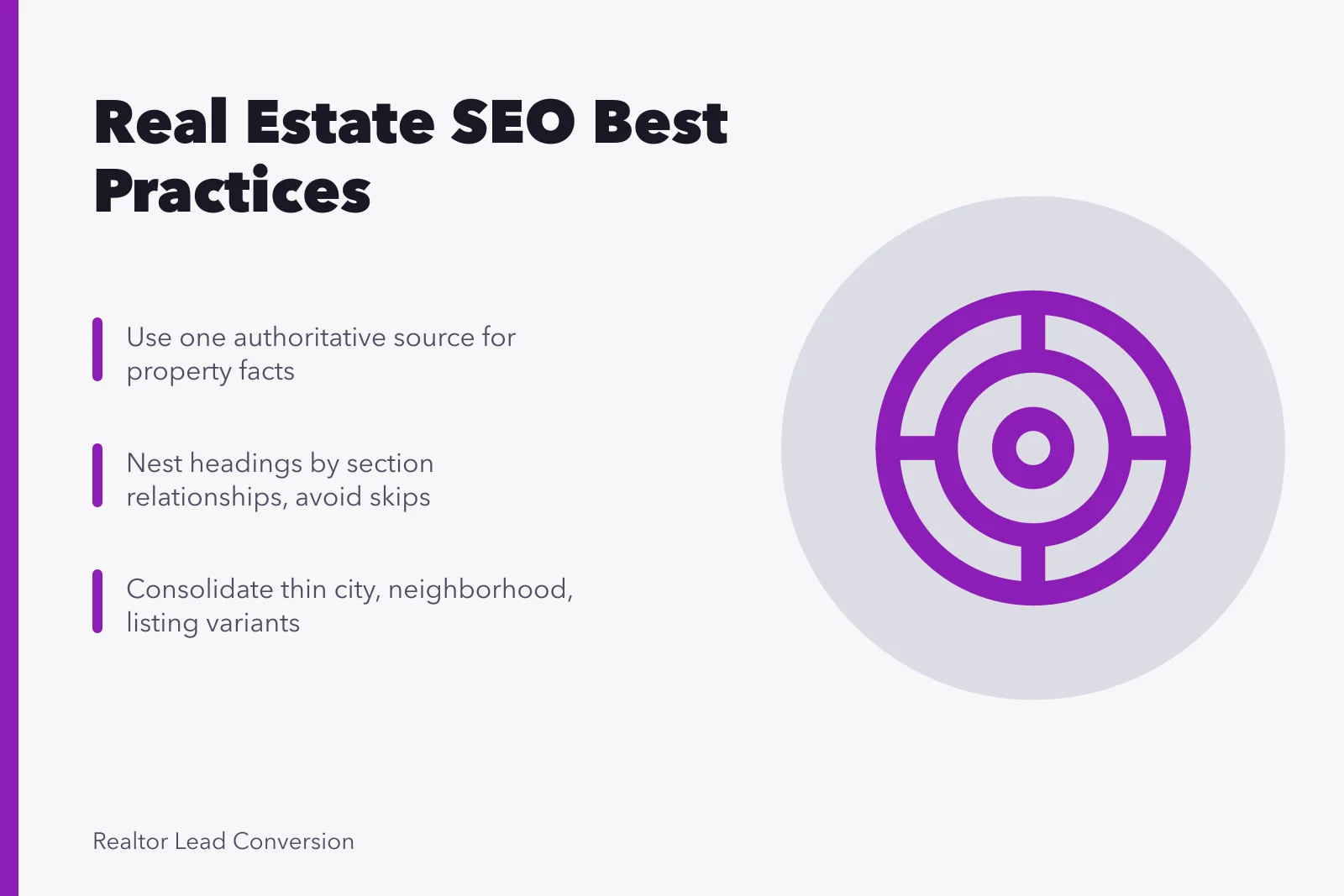
Use usable navigation and descriptive links so every intended page can be reached. Keep sitemaps aligned with canonical, current URLs. Build an indexability policy by page class, not through scattered exceptions. Consolidate thin city, neighborhood, listing-filter, or service variants that cannot provide distinct evidence and a durable purpose.
Treat a city guide, a listing detail page, and a brokerage service page as three classes, each with its own owner and update trigger.
Page Discoverability Checklist
- Usable navigation and descriptive links
- Sitemaps aligned with canonical URLs
- Indexability policy by page class
- Consolidate thin city and listing variants
- No scattered exceptions
Measure performance and indexability
Check Core Web Vitals thresholds in the field: Largest Contentful Paint under 2.5 seconds, Interaction to Next Paint under 200 milliseconds, and Cumulative Layout Shift under 0.1. Use Google Search Console's Coverage and Performance reports to confirm every intended URL is indexed and to spot crawl errors, soft 404s, or canonical mismatches before they drain a listing page's visibility.
Treat images as page content
Google's image SEO best-practices guide recommends standard HTML image elements, accessible and relevant landing pages, descriptive text alternatives, responsive images, supported formats, quality with sensible performance, and image sitemaps where useful. Verify creator, rights, property authority, subject, context, dimensions, loading, text alternative, and removal behavior for every media class.
A property photograph should not imply a current condition, view, boundary, amenity, unit, or availability it does not show. Give informative floor plans, charts, maps, and diagrams the explanation needed for their purpose. Keep decorative images from adding noise. Record the source and update trigger, especially when a listing or development changes.
Use headings for meaning and navigation
The W3C Web Accessibility Initiative's heading structure tutorial says headings communicate content organization and can support in-page navigation for browsers and assistive technologies. It recommends nesting ranks by section relationships and avoiding confusing skips where possible. Target WCAG 2.1 Level AA, which requires satisfying all Level A and Level AA success criteria or providing a Level AA conforming alternate version.
Use one descriptive page topic and a logical outline. Do not insert query variants as headings when they do not introduce real sections.
Keep business and property facts controlled
Assign one authoritative source and one accountable owner to office identity, practitioner roles, licenses, services, contact routes, listing status, price, open-house time, property features, media, and accessibility information. Reconcile published pages and external profiles. Use state-triggered updates and a tested removal or archive path instead of periodic manual cleanup alone.
Worked example: a seller accepts an offer, so the price changes and the status moves to pending the same afternoon. The listing detail page, the search snippet, the featured card on a city guide, and the syndicated feed still carry the old figure. Update the listing feed first, re-render each surface, then check the hand-edited ones.
Comply with the Fair Housing Act in listing and neighborhood copy
The Fair Housing Act (42 U.S.C. § 3604) prohibits discriminatory language in real estate advertising. Review every city guide, neighborhood page, and listing description for terms that steer by race, color, religion, sex, familial status, national origin, or disability. HUD's Fair Housing Poster must be conspicuously displayed. Keep neighborhood descriptions factual—schools, transit, parks, crime statistics from public sources—without coded language that implies a protected class is welcome or unwelcome.
Add structured data for listings, agents, and local business
Keep one JSON-LD block per page class, generated from the same source as the visible page. Use Organization and LocalBusiness sitewide with name, address, phone, and hours. Agent pages use RealEstateAgent with areaServed and the office it belongs to. Listing pages use RealEstateListing with the property, price, availability, and status.
Validate with the Rich Results Test and the Schema Markup Validator before release.
Build local presence through Google Business Profile
Claim and maintain the brokerage's Google Business Profile with exact name, address, and phone (NAP) matching the site footer and every citation. Add service-area listings for each agent. Respond to reviews within 24 hours. Submit photos tied to current listings. NAP consistency across the site, the profile, and local directories feeds the local pack and map results that drive realtor lead conversion.
Best-practice review table
| Area | Control | Evidence |
|---|---|---|
| Architecture | Distinct page classes | Purpose and owner map |
| Media | Rights, context, alternatives | Asset record and task test |
| Structure | Logical semantic outline | Rendered heading review |
| Facts | Source and state triggers | Reconciliation log |
Release through representative template samples, device and assistive tests, fetch and render checks, directives, canonicals, structured data, analytics, monitoring, and rollback. Compare stable page and query groups. Keep correction volume, task failures, field performance, qualified inquiries, and service capacity visible beside impressions and clicks.
Measurement example: compare a city guide page group against the queries that land on it, and track a listing group before and after a template change. A correction signal looks like more price or status fixes filed against one template within a week of release.
Respect MLS and IDX feed authority
The Internet Data Exchange (IDX) rules set by the National Association of Realtors govern which listings may appear on a brokerage website and how they must be displayed. Pull listing data from the MLS feed, never from scraped portals. Honor the feed's status codes (active, pending, sold, expired) so a published page never contradicts the authoritative record. Flag any listing whose MLS status changed within 24 hours for immediate page and structured-data update.
Assign SEO ownership and QA
Assign one accountable owner for Google Search Console coverage and performance reports, one for GA4 event tracking tied to listing inquiries, and one for the canonical and redirect map. Review Search Console's URL Inspection and Coverage reports weekly for indexability gaps, and log every template or canonical change in the CMS release history with author, date, and affected page class.
Before each release, validate Core Web Vitals in the field using PageSpeed Insights or the Chrome UX Report. QA a sample of each page class for heading order, alt-text accuracy, structured-data validity, and mobile rendering. Roll back any template that pushes a page group below the LCP, INP, or CLS thresholds.
Common questions
How many pages should a real estate site publish?
Publish only the page classes and instances that serve distinct decisions with verified facts, useful material, accountable ownership, and a sustainable update or retirement path.
Should keywords appear in every heading?
No. Use natural, descriptive headings that reflect genuine sections. Repetition that harms clarity or exists only to manipulate search can reduce usefulness.
Are image filenames more important than alt text?
They serve different roles. Prioritize accurate context, authorized media, purpose-based text alternatives, standard embedding, useful quality, dimensions, and performance as a system.