Careers
Part of Getting Real Estate Marketing Strategy Right the First Time
The Real Estate Marketing Strategy Trends That Will Still Matter Next Year: The 2027 View
real estate marketing strategy trends for 2027 include representation, ad-delivery records, first-party evidence, governed AI, accessible media, and portability.
What to take away
- Treat each trend as a scenario with a signal, owner, review date, safe experiment, maximum loss, and stop rule.
- Earlier representation education, ad-delivery evidence, governed AI, and accessible remote media will require operating records, not slogans.
- First-party evidence and vendor portability become useful only when the business controls rights, accuracy, privacy, accounts, exports, and correction.
Real estate marketing strategy trends should be treated as scenarios, not predictions. This independent outlook was checked in August 2026. Housing markets, rates, laws, platforms, MLS policies, technology, and consumer behavior can change before or during 2027.
Representation becomes part of early education
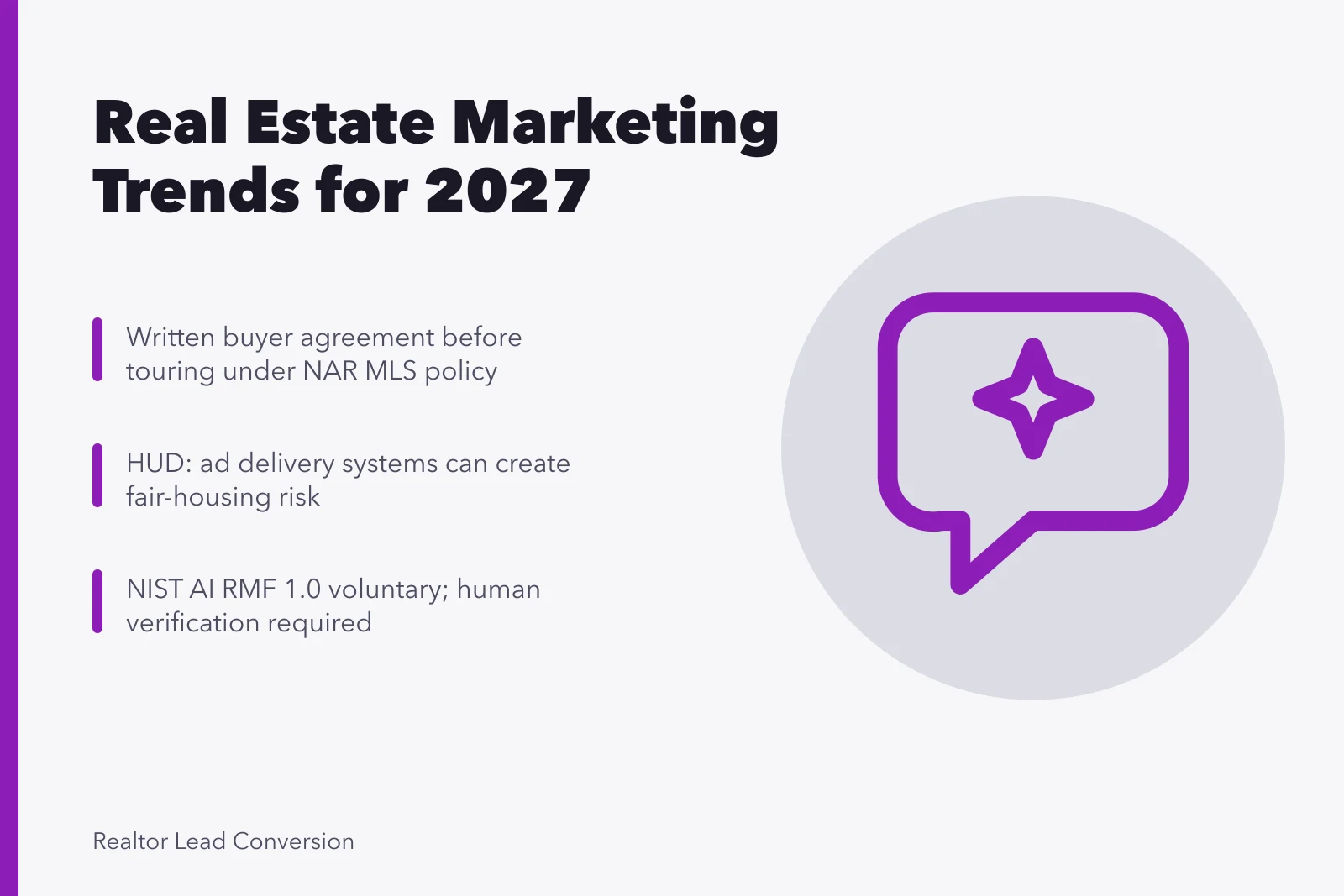
NAR's current written buyer agreement policy statement requires covered MLS participants working with a buyer to enter a written agreement before touring and identifies required terms. This is association MLS policy, not universal law; local requirements may differ.
For covered teams, align early education, staff explanations, forms, and services. Align compensation language and timing, and do not let marketing and operations describe different relationships. Outside that association policy, teams should verify the law and rules that actually apply.
Ad delivery receives more scrutiny
HUD's digital-platform guidance says selection tools, custom or mirror audiences, and delivery systems can create fair-housing risk. Teams need records: intended reach, excluded settings, creative, delivery. They need outcomes, reviewer, remediation. HUD's 2022 agreement with Meta Platforms over housing ad delivery is a dated example of that scrutiny.
Fair-Housing Ad Delivery Records
- Intended reach
- Excluded settings
- Creative
- Delivery
- Outcomes
- Reviewer
- Remediation
Buying a housing ad category from a platform does not transfer all responsibility. Fair-housing risk records pair well with the real estate marketing strategy tools that track audience settings and delivery outcomes.
First-party evidence matters more
Dated local process guides, client questions, property records, original market analysis, and documented service performance can distinguish a business from generic content. They also require copyright and trademark licenses, client consents, privacy notices, method notes, expert review, an update owner, and a correction log. More proprietary data is useful only when the firm can govern it.
AI shifts toward controlled assistance
NIST's current AI Risk Management Framework page calls AI RMF 1.0 voluntary guidance, links a generative AI profile, and notes an active revision. No real estate tool approval; no 2027 adoption prediction.
Use it for task-specific governance, mapping, measurement, risk response, then require human verification of property facts, neighborhood language, credentials, availability, and scoring.
Writing, images, chat, translation, transcription, scoring, valuation support, and analysis will require task-specific approval.
Accessible remote property evidence expands
Virtual tours, plans, and video help people evaluate options before travel. Captions, transcripts, image alternatives, keyboard access, and readable documents help.
Teams must distinguish completed, proposed, staged, simulated, and altered conditions. They protect privacy, confirm media rights, qualify measurements, provide equivalent ways to obtain material information.
Accessible media and clear condition labels shape property listing marketing decisions teams make for every new listing.
Portability becomes a vendor test
Brokerages will ask who owns domains, profiles, ads, CRM records, permissions, analytics, listing media, source files, reporting definitions, and AI records. Test account recovery, staff departure, correction, data export, vendor suspension, and campaign withdrawal in a pilot.
Trend test record
| Scenario | Early signal | Bounded test |
|---|---|---|
| Representation | Questions arise earlier | Audit one journey |
| Ad delivery | Evidence requests grow | Review one campaign |
| Governed AI | Task controls become standard | Trace one output |
| Accessible media | Remote evaluation expands | Test one listing |
| Portability | Exports affect selection | Restore one package |
Set maximum loss as the smallest budget, staff hours, or listing exposure the team can absorb. Set the stop rule as the first result that triggers a pause and review.
Maintain a dated watchlist
The NIST AI RMF Playbook organizes voluntary AI-risk actions. Use them when AI changes real estate marketing strategy trends; the playbook is not a product ranking or forecast.
The W3C Privacy Principles statement defines privacy concepts for web systems. Apply them to real estate marketing strategy trends, then check the governing law and actual configuration.
Common questions
Are these trends predictions?
No. They are planning scenarios based on current policy and guidance. Watch a specific local signal, such as a new MLS rule, a HUD inquiry, or a platform ad-policy update, before changing a material decision.
Will AI replace real estate marketing teams?
That conclusion is unsupported. AI can assist defined tasks, while people remain responsible for authority, facts, access, privacy, review, correction, service, and regulated conduct.
Which trend should be tested first?
Test the scenario with the largest plausible effect on the current client decision or risk, using a small reversible experiment and a written stop rule.