Strategy
Part of An Eight-Week Real Estate Lead Generation Pilot, Compared to Ad Hoc Outreach
What Separates the Strong Real Estate Lead Generation Examples From the Weak
real estate lead generation examples for 2027 show six distinct programs for sellers, buyers, open houses, relocations, investors, and property managers.
What to take away
- Strong named programs from Zillow Premier Agent, Realtor.com Connections Plus, Redfin Partner Program, HomeLight and Compass give each lead a licensed owner and a bounded next step. Weak ones leave a bare form, a stale list or an unassigned portal inquiry.
- Each example connects one audience decision to a bounded resource, next step, evidence set, and service owner.
- The six patterns below are hypothetical operating patterns, not client results, endorsements, or performance promises.
- Local market data can shape questions, but its population and limits must stay visible.
Real estate lead generation examples are useful only when they show the complete path from a specific need to a serviceable next step. The six patterns below are hypothetical. Adapt them to the licensed role, actual market, fair-housing duties, data rules, platform terms, brokerage controls, and staff capacity.
Named programs show the contrast. Zillow Premier Agent sells placement and lead routing. Realtor.com Connections Plus sends buyer and seller inquiries to agents. Redfin Partner Program refers clients to partner agents who pay a referral fee, typically 20% to 35% of commission.
HomeLight matches sellers and buyers with agents, usually for a referral fee near 25% to 30%. Compass runs listing and open-house tools.
1. First-time buyer process clinic: HUD sequence vs an unowned portal form
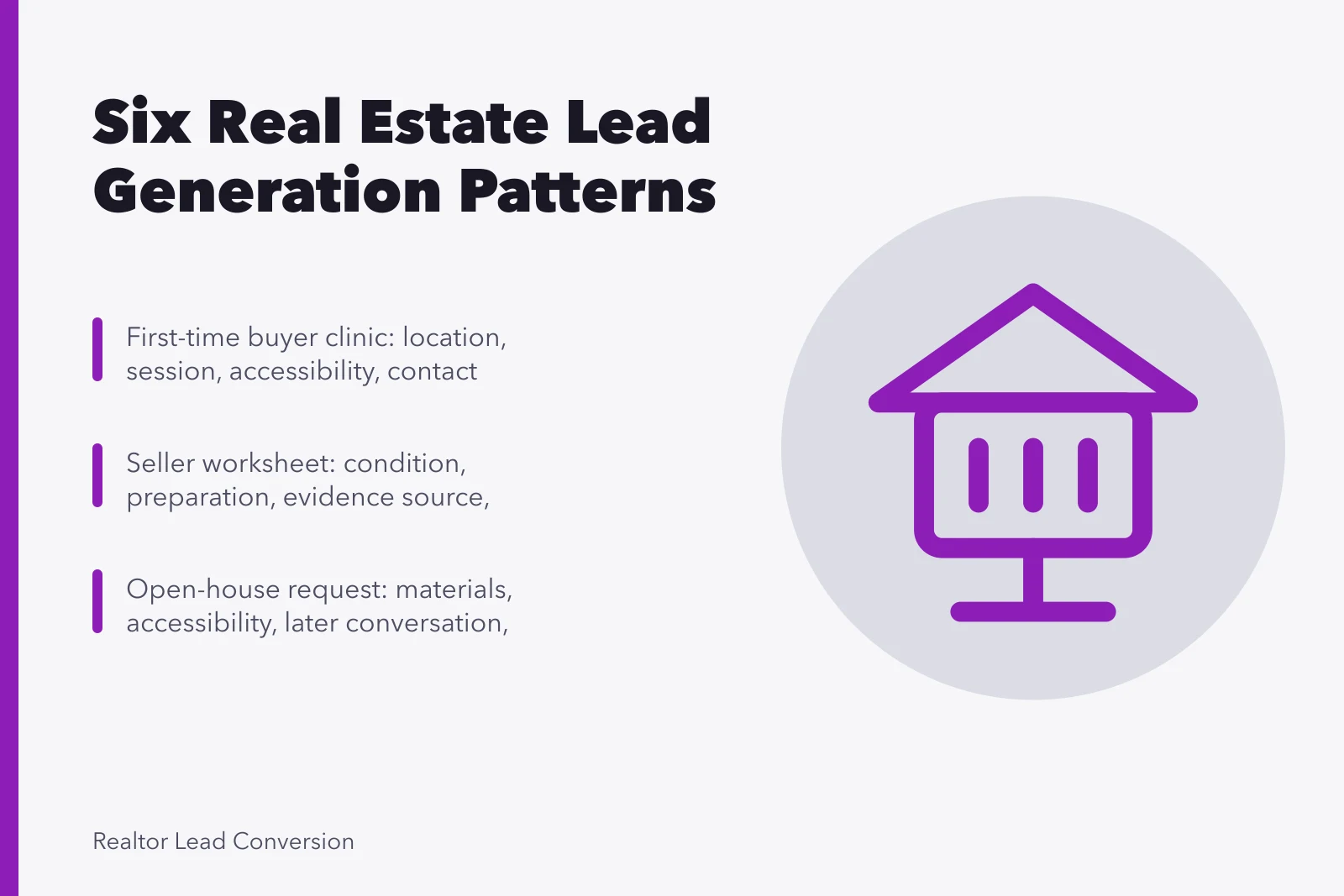
Offer a scheduled session that explains major stages, questions to ask providers, and where personalized financial or legal advice begins. The form requests only the location, preferred session, accessibility needs, and contact channel required to deliver the event. The outcome is attendance and a stated next decision, not loan eligibility or purchase readiness.
First-Time Buyer Process Clinic
- Explain major stages
- List questions to ask providers
- Mark where personalized advice begins
- Form asks location, session, needs, channel
- Outcomeattendance and next decision
HUD's Buying a Home resource organizes consumer information into nine topic areas: affordability, rights, loan shopping, programs, home shopping, offers, inspection, insurance, and closing. It is general U.S. education and does not replace local or individualized advice.
Use the sequence to check whether a clinic covers the buyer's decision without promising a loan, price, property, or outcome. Zillow Premier Agent, Realtor.com and Homes.com can supply buyer inquiries. A named program works when each inquiry reaches a licensed agent or ISA with a logged follow-up. A bare "Request a tour" form left unassigned does not.
2. Seller preparation decision sheet: HomeLight and SmartZip vs a bought expired list
Create a worksheet separating observable condition, optional preparation, evidence source, and estimated range. Separately track responsible provider and unresolved question.
Next is a documented review, not an instant valuation. Expire market claims; keep the version sent so the team can correct it when facts change. Teams with versioned records still need to answer common real estate lead generation questions about who qualifies and who decides.
HomeLight and SmartZip are named seller-lead sources. NAR's 2024 Profile of Home Buyers and Sellers reports that 7% of sellers sold without an agent. A versioned preparation sheet reviewed by a person works. A bought expired list with a headline price and no evidence source fails the same test.
3. Open-house information request: Compass and Spacio vs a paper clipboard
Let visitors request property materials, accessibility information, or a later conversation without forcing unrelated fields. Identify who will respond and preserve the exact request. Keep property authority, availability, features, images, and withdrawal synchronized from one controlled record. Count material delivery separately from appointments.
Compass and Spacio are named open-house tools. NAR's Profile of Home Buyers and Sellers reports that 4% of buyers found their agent at an open house. A sign-in that lands in the property record and a CRM task works. A paper clipboard at any brokerage does not.
Keller Williams and eXp Realty teams can run strong open houses if sign-in data lands in Follow Up Boss, kvCORE or Sierra Interactive.
4. Relocation requirements brief: Cartus and ACS data vs a generic HR form
Collect work location or travel constraints, timing, housing type, budget range if voluntarily supplied, and requested help. Avoid neighborhood descriptions that imply who belongs. Provide objective, sourced information and let the client decide which factors matter. Route unanswered legal, tax, school, accessibility, and immigration questions to qualified sources.
The Census Bureau's American Community Survey information guide explains the ACS produces detailed population and housing data. It separates one-year estimates, 12 months of data for larger geographies, from five-year estimates, 60 months for all areas.
Aggregate survey estimates are context, not facts about an individual or a marketing-performance benchmark, so record the table, geography, vintage, universe, and estimate. Record uncertainty and retrieved date before using ACS evidence in a relocation brief.
Cartus and Weichert Realtors are named relocation providers. ACS one-year estimates cover geographies with populations of 65,000 or more. A brief with assigned counselors and ACS context works. An HR form that drops the family into a portal search does not.
5. Small-investor operations review: BiggerPockets and Roofstock vs a no-money-down seminar
Offer a template for documenting property type, management burden, maintenance questions, record needs, and professional advisers. Do not advertise projected returns without support or turn a marketing call into tax, securities, lending, or legal advice. The lead qualifies through service fit and requested next step, not a presumed net worth.
BiggerPockets and Roofstock are named investor resources. A typical single-family rental management fee ranges from 8% to 12% of monthly rent. A template, data source and service-fit call works. A no-money-down seminar that promises projected returns does not.
6. Property-management scope comparison: Buildium and AppFolio vs a services page with no price basis
Publish a side-by-side explanation of leasing, maintenance coordination, reporting, resident communication, inspections, emergency coverage, vendor controls, pricing basis, and exclusions. The form asks which scope the owner wants to compare. The next step confirms property type, jurisdiction, authority, and capacity before a proposal.
Buildium and AppFolio are named property management systems.
Buildium plans typically start near $58 per month for Essential and $183 for Growth as of 2026. AppFolio Core commonly carries a $280 monthly minimum in many markets.
A page that lists services without a price basis or exclusions fails the same test. RentManager and Propertyware also publish feature and pricing information.
What each example measures
| Named example or pattern | Primary decision | Measured next step |
|---|---|---|
| Buyer clinic | Understand the process | Attended session |
| Seller sheet | Compare preparation | Documented review |
| Open house | Request information | Material delivered |
| Relocation | Define requirements | Accepted brief |
| Management | Compare service scope | Qualified consultation |
| Zillow Premier Agent buyer lead | Tour or agent contact | Agent assigned and responded |
| HomeLight seller match | Compare preparation | Documented review |
| Buildium vs AppFolio scope | Compare service scope | Qualified consultation |
How to test each example for privacy and accessibility
The NIST Privacy Framework starting guide gives a voluntary process for privacy risk. For each lead-gen example, use it to name one person who owns the data and one person who owns the response. It is not legal clearance.
The W3C information and relationships explanation says visual structure and relationships should also be programmatically available. Apply that check to real estate lead generation forms: labels, required fields, and error messages must stay tied to their inputs for screen readers. Then test the live page with the users and technology in scope.
Strong teams connect Zillow Premier Agent, Realtor.com, HomeLight and Redfin leads into Follow Up Boss, kvCORE, Sierra Interactive, BoomTown, Real Geeks or Ylopo. Weak programs send every source to a shared inbox.
Common questions
Are these proven campaign results?
No. They are hypothetical design patterns and make no client, revenue, conversion, cost, ranking, or transaction claim.
Can all six examples use one form?
Shared infrastructure may help, but each offer should keep its purpose, fields, notice, permission, routing, service boundary, and disposition distinct.
Which example should be tested first?
Choose the verified client decision the team can serve most accurately and consistently with a bounded audience, clear evidence, and complete handoff.