Operations
Part of An Eight-Week Real Estate Lead Generation Pilot, Compared to Ad Hoc Outreach
How to Improve Real Estate Lead Generation by Diagnosing the Real Constraint
how to improve real estate lead generation in 2027 starts with a diagnosed constraint, safer targeting, clearer forms, faster service, and controlled experiments.
What to take away
- Diagnose the failing stage before changing traffic, creative, or forms.
- Housing-ad settings and delivery deserve an access review; platform options do not transfer responsibility.
- Improve one bounded variable at a time and judge it with quality, service, cost, access, and complaint evidence.
How to improve real estate lead generation starts with a constraint, not a new channel. Map captured, valid, accepted, contacted, connected, qualified, scheduled, attended, and agreed stages. Add invalid, duplicate, suppressed, misrouted, unreachable, and unserved outcomes. The largest quality-adjusted loss identifies the first investigation.
Typical U.S. paid-search buyer leads run about $20 to $70 per valid lead, and contact rates commonly land between 20 and 40 percent when the first attempt happens within five minutes. Size each loss against a watch threshold, then set your own from your last 90 days.
| Stage | Watch threshold |
|---|---|
| Captured to valid | Under 60 percent valid |
| Valid to contacted | First attempt over five minutes |
| Contacted to qualified | Under 25 percent qualified |
| Qualified to attended | Under 50 percent attended |
Pick the sources worth testing
Test one source job at a time. Paid search reaches people close to a decision. Social buys reach, so expect lower intent.
Referral sends the highest-intent leads, held by a fast thank-you and a clear intake rule. IDX catches visitors already browsing your listings.
Check audience access before reach
Document the client situation, service area, exclusion rationale, campaign settings, delivery evidence, and reviewer. Do not use a protected trait or a convenient proxy to shape housing access. Compare intended and actual delivery where reliable evidence exists, and pause when the audience logic cannot be explained or reviewed.
Audience Access Review
- Document client situation and service area
- Record exclusion rationale and campaign settings
- Keep delivery evidence and reviewer notes
- Avoid protected traits and proxies
- Compare intended vs actual delivery
- Pause if audience logic is unexplained
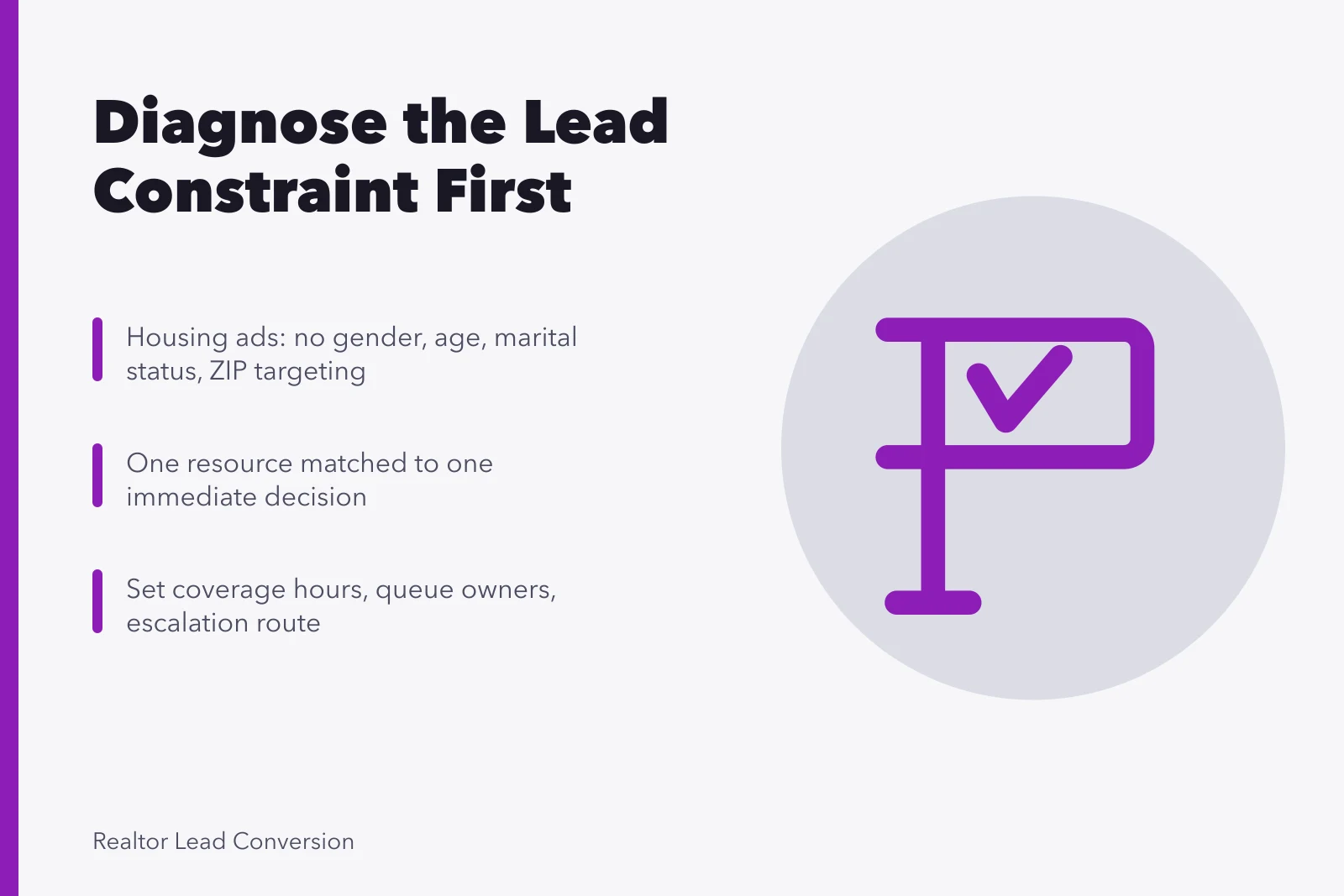
Google's housing personalized-advertising policy blocks U.S. and Canadian housing advertisers from targeting by gender, age, parental status, marital status, or ZIP code. It allows city-level or broader location targeting and radius targeting of at least one kilometer.
These are platform rules, not the full law or a guarantee of fair delivery. Verify current settings and independently review the actual campaign and results.
Repair the offer and capture path
Match one resource to one immediate decision. State what arrives, when, from whom, and what information is required. Remove fields that do not serve that exchange. Test visible labels, instructions, errors, keyboard use, mobile entry, confirmation, privacy notice, source capture, and withdrawal. A shorter form is useful only if the downstream team can still route and serve the request.
Improve response, not just speed
Set coverage hours, queue owners, absence rules, escalation route. First response should identify the sender, confirm the request, deliver the promised item or a clear next step, and avoid unrelated pressure.
Name the routing owner in a tool such as Follow Up Boss, kvCORE, or Sierra Interactive, and confirm leads land with a person, not a shared inbox. Sample first response: 'Hi [name], this is [agent]. I have the three [street] listings you asked about. Are you free at 4pm or 6pm today?'
Sample conversations for accuracy, respectful treatment, record quality, and whether a person's stated channel or stop request was honored. Response speed and respectful treatment are core promises in any real estate agent branding system.
Verify automated delivery
The Justice Department's United States v. Meta Platforms case page says a 2022 settlement followed allegations that Meta's housing-ad system used algorithms that discriminated based on Fair Housing Act protected characteristics. It records the discontinued Special Ad Audience tool and a variance-reduction system with compliance targets.
This historical case does not describe every current platform. It shows why advertisers should preserve settings, delivery evidence, review methods, and corrective decisions.
Use a controlled test
Test
- Low valid rate
- Clarify offer and fields
- Slow response
- Add queue coverage
- Poor qualification
- Refine service questions
- High cost
- Narrow one channel job
Keep only if
- Low valid rate
- Validity rises without access loss
- Slow response
- Service improves without unsafe contact
- Poor qualification
- Useful conversations improve
- High cost
- Quality-adjusted cost improves
Worked example, illustrative figures. The stage map shows 70 percent valid but only 30 percent of valid leads contacted within one hour, at about $45 per paid-search lead. Coverage, not creative, looks like the constraint.
The test adds an evening queue shift for 14 days, holding campaign and form fixed. Keep it only if one-hour contact rate rises without higher cost per qualified lead.
Predefine the hypothesis, changed element, audience, duration, minimum evidence, guardrails, and stop rule. Keep definitions stable. Review access, consent, complaints, service failures, and full cost beside conversion. One winning period does not prove a durable effect, especially when inventory, rates, staffing, or season changed.
Control the handoff
The GOV.UK technology selection guidance recommends adaptable choices, data control, security review, and ownership-cost analysis. Use those public-service questions when assessing how to improve real estate lead generation; they are not product endorsements. A controlled handoff also depends on a realtor lead follow-up system that keeps working while the agent is with clients.
The CISA software acquisition fact sheet covers development practice, supply-chain exposure, deployment, and vulnerability management, which are the questions to ask about the routing tool that receives your handoffs.
Common questions
Should a team buy more leads to improve results?
Only after it proves that current leads are valid, permissioned, routed, served, and measured consistently. Added volume can magnify a broken handoff.
Is a higher form conversion rate always better?
No. Check qualification, accessibility, permission clarity, duplicates, downstream service, complaints, and later outcomes before accepting the change.
How many variables should one test change?
Change one primary variable when practical. If the system requires a bundled change, document every component and avoid claiming which one caused the result.