Rules
Part of Getting Real Estate Marketing Strategy Right the First Time
Marketing Strategy Case Studies: Baselines, Funnels, and Transfer Tests
real estate marketing strategy case studies in 2027 need a market, baseline, audience, total inputs, funnel, controls, limits, attribution, and transfer test.
What to take away
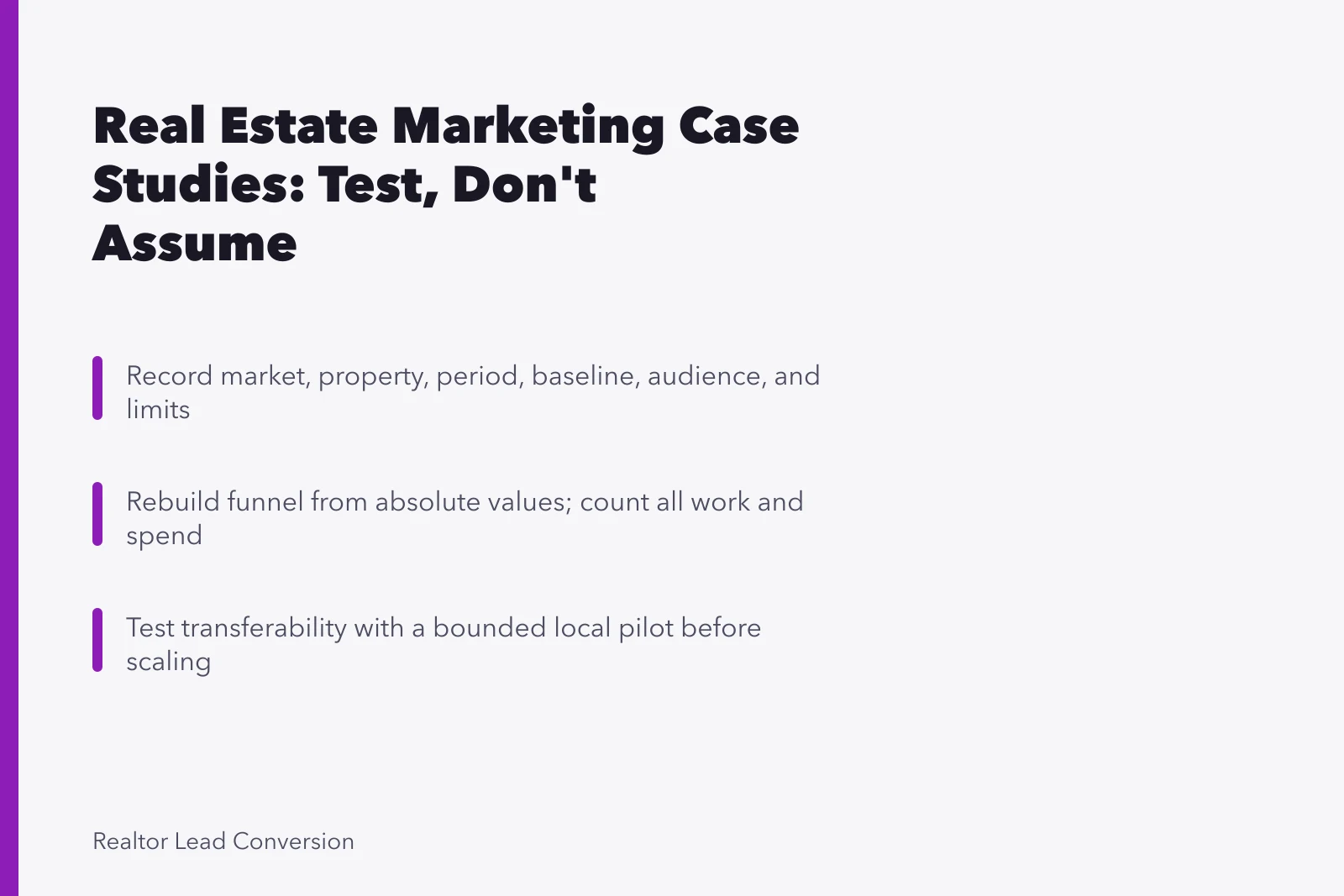
- To judge a real estate case study, ask for the exact setting, a dated baseline measured the same way as the result, every cost including staff time, and the funnel in absolute numbers. Then prove transfer with a small local pilot.
- A percentage gain with no baseline is not evidence. Ask for both absolute values and the stage definitions behind them.
- Rebuild the funnel from lead to closed transaction and count the work the vendor left outside the media budget.
- Public performance claims fall under the FTC substantiation standard, so a vendor should hold records before publishing numbers.
- Transfer fails when your market, price band, licensing or service capacity differs. Match conditions first, then pilot with stop rules.
What a credible case study discloses
Record country, locality, period, property type, transaction side, client situation, price band, team and licensing context. A luxury launch, a rental campaign and a first-time buyer program do not supply interchangeable evidence. Without the setting, no reader can judge whether the numbers travel.
Setting Details to Record
- Country, locality, and period
- Property type and transaction side
- Client situation and inventory
- Price segment and brand position
- Team and licensing context
- Channel access
Baseline figures to request
Ask for the baseline and the result measured on one definition, inside one time window. A vendor reporting "leads up 40 percent" should also report absolute counts on both sides and the dates. Market context belongs beside the campaign number, not inside it.
Definitions matter more than the label. A lead can mean a form fill, a call or a portal inquiry, and each carries a different cost and close rate. Published benchmark baselines and outliers show how far a market can move a result with no campaign at all.
| Area | Required detail | Weak substitute |
|---|---|---|
| Setting | Market, period, property, role | Brand name |
| Baseline | Same measure, same window | "Before" label |
| Inputs | All work, spend, systems | Media budget |
| Result | Absolute funnel and limits | Percentage alone |
| Transfer | Matched conditions, pilot | Vendor assurance |
Baseline Data to Request
- Prior qualified inquiries and response coverage
- Consultations, agreements, and tours
- Offers, completed outcomes, and cycle time
- Cost, complaints, opt-outs, and corrections
- Listing accuracy using same definitions
- Market, rate, staffing, inventory changes
Example: reading a funnel with typical ranges
Treat these as typical ranges rather than a verified case. A suburban resale campaign might report 400 to 600 leads in 90 days at $40 to $70 per lead, with 8 to 15 percent becoming appointments and 1 to 3 percent closing.
That arithmetic shifts fast. Six hundred leads at a 2 percent close rate is 12 transactions. One hundred fifty leads at 6 percent is nine. The funnel shape matters more than the headline conversion figure.
Count duplicates and invalid contacts as well. A list padded with resold portal leads can look large and convert poorly. Rebuild each stage yourself. That is the discipline behind marketing analytics that survive contact with real data, and it is the only way to compare two funnels fairly.
Costs the media budget hides
Include internal labor, agency fees, portal spend, data, website, CRM, content, photography, video, events, partner value, compliance review and technology. Separate setup work from ongoing work. Ask which accounts, assets and permissions stay usable after the period ends.
Phone follow-up carries its own duties. FTC guidance on the Telemarketing Sales Rule covers the disclosure and calling rules agents meet when they work a lead list by phone.
Fair housing, RESPA and claim review
HUD guidance explains that housing-related digital targeting and delivery can create discrimination risks. Check contact permission, accessible alternatives, review incentives and partner payments. A high conversion rate does not excuse an unlawfully narrow campaign.
Agents working US leads should read how RESPA and Fair Housing rules shape conversion before copying a targeting method from any case.
The FTC advertising substantiation policy requires a reasonable basis before objective performance claims go public. Review guidance from the same agency warns about fake feedback, selective requests, conditioned incentives and paid rankings.
The transfer test
An observed result in a case is not proof of cause. The CDC program evaluation framework separates observed outcomes from wider impacts and notes that observational case studies generally do not establish causation. It was written for public health programs, yet the discipline transfers to campaign evidence.
- List the case conditions that match your businessmarket, price band, property type, lead source, team size.
- Mark the conditions that do not match, and judge whether each changes the expected result.
- Rebuild the funnel in your own countsleads, qualified inquiries, appointments, agreements, closings.
- Set a budget and a stop rule for a pilot of 60 to 90 days.
- Compare the pilot with your own baseline rather than the case study figure.
Ask the vendor what it cannot promise. Compare provider claims against what agents ask about marketing strategy before you commit budget.